Who is walking inside you as you read this line?
Right now, as you read this sentence, tiny loads are on the move inside your cells. What carries them is a protein that the cell makes itself. It walks step by step along a thin track. It swings its two ends, which grip the track, forward in turn, just like someone walking on two feet. It has no eyes and no brain to read an address. What lets it find its way is the track it walks on: in long nerve fibres the tracks are lined up in the same direction, and this carrier steps towards one particular end of the track.
In nerve cells many of these loads are made in the cell body, but they are also needed at the far end of the long extension. So how long is this road? In some nerve cells, about a metre. Yes, a metre inside a single cell. That is more than half your height.

- about 1 metreIn some nerve cells: a single cell, more than half your height.
- Made in the body, needed at the endMany loads are made in the cell body, but they are needed at the far end of the extension.
Can the load not get there by itself?
Small things spread out on their own in the cell fluid, like ink dripping into water. Over a short distance, that is enough. But there is a catch: if the road becomes twice as long, the wait becomes four times as long.
According to a rough calculation for a protein, covering one centimetre this way takes about two weeks. One metre? Centuries. By this calculation, not even a human lifetime would be enough. Of course, these are not times measured for every load; it is a calculation that shows what a huge obstacle distance is. That is why transport proteins matter: they move the load along the tracks in a set direction.
What if the courier’s step were a metre long?
Let us try a thought experiment: imagine enlarging only this carrier’s step to one metre. Not its body, just its step. In the laboratory it takes about a hundred steps per second. If it kept up that pace, it would travel at about 360 kilometres an hour, and on foot at that.

- about 8 nanometresIts real step
- about 100 steps per secondIn the laboratory
- about 360 km an hourEnlarge only its step, not its body, to a metre
- about 125 million stepsOne metre, in real steps
Its real step is about 8 nanometres. More than six thousand of these steps would fit across the thickness of a hair. Covering a one-metre road with these steps means about 125 million steps. For the courier whose step we enlarged to a metre, the same road would be about three times the circumference of the Earth. But this does not mean that a single carrier walks the whole way without ever stopping.
Its speed is not the same everywhere, either. In the laboratory it is measured at about 800 nanometres per second. The same source gives about 2,000 nanometres per second for a living cell. A lab dish and the inside of a cell are not the same place, and no carrier has a single speed.
Where does this courier come from, and what does it carry?
The courier is also a protein. The cell makes it by reading the recipe in its hereditary information. The tracks it walks on are part of the cell’s internal skeleton. The load it carries is sometimes a membrane sac and sometimes one of the cell’s energy-producing compartments.
The courier grips the track, walks, and can then let go. In the laboratory a typical walk lasts about a hundred steps. That is a distance shorter than even a thousandth of a millimetre. So a one-metre journey is not a marathon run by a single courier without a break. More than one courier can hold on to a load at the same time. According to a model built on experiments with nerve cells grown in culture, a courier that lets go of its load drifts freely for a while and can then grip a load again; along the way, the load often changes hands between couriers.
A courier that drops off its load does not necessarily end up in the bin, either. The same study found that couriers were not broken down after their work and were not carried back by carriers moving in the opposite direction; in other words, the same protein can make more than one trip. But the couriers that drift freely all the way back to the cell body are only a small share; according to the researchers, this way of returning is not effective over long roads. How this limit is overcome in very long extensions is not yet clear.
Besides production and transport, the cell also does its cleaning. Worn-out parts are processed and recycled in the cell’s digestive compartments.
How long can the roads of a single cell become?
A cell’s roads are not only long; they can also be highly branched. Starting from rat data, researchers made an estimate in humans for a particular group of nerve cells in the brain. According to this estimate, the branches of a single cell can add up to more than four metres, that is, more than two adult heights. According to the same estimate, this cell can form more than a million connections: if you made one connection a day, reaching that number would take you about 2,700 years.
These four metres are not a straight road; they are the total length of a network that forks like the branches of a tree. According to the researchers’ computational model, the energy cost of sending the electrical message along the branches of this network and of rebalancing the membrane rises as the network grows. This is one of the candidate factors that might explain why these cells can be damaged more easily in a nerve disease.
Why does the same distance sometimes take years?
If the couriers are this fast, why would a load stay on the road for years? Because not every load travels at the same speed.
According to a review that summarises animal studies, some membrane-wrapped sacs travel about 5 to 40 centimetres a day. At that speed, a metre takes anywhere from a few days to a few weeks.
The building blocks of some of the internal skeleton’s threads, and of the tracks the couriers walk on, move much more slowly: in animal studies, about 0.2 to 1 millimetre a day. Even at the fastest end of this range, a metre takes close to three years; at the slowest end, more than ten. But not every slow load is like this. Some proteins used in the cell’s everyday work belong to another, faster group of slow transport. The time depends on the load’s group and its speed.
But not every load is in a hurry
Some sacsabout 5-40 cm a day
1 metre: a few days to a few weeksBuilding blocks of the tracks and some skeleton threadsabout 0.2-1 mm a day
1 metre: close to three years to more than tenWhat is more, the skeleton threads do not really creep along. Threads followed in cell culture ran fast for a short time, then stopped for a long time. What brings the average down is not the walking itself but those long pauses. For the building blocks of the tracks, this pattern is not yet as clear.
These estimates of years do not come from following a single package from start to finish in the human body; they come from applying the speed range measured in animals to one metre. And what is carried is not a message, but material needed for the structure and workings of the extension.
Can the inside of a cell be renewed while the cell stays the same?
How old are the nerve cells in your cerebral cortex? A study using human samples showed that these cells form around the time of birth. With the methods used, no new cells could be detected being added in adulthood. So those cells are largely the same age as you. This does not mean that no new nerve cells form in any part of the brain.
But an old cell does not mean that every part inside it is old. Couriers can carry new material for years, and worn parts can be renewed. The building stays the same; the furniture inside changes.
What sets the courier’s speed?
The courier has no speedometer. Each of its steps is linked to the cell’s small energy-carrying molecules and to changes in its own shape. In laboratory experiments under low load, about one energy molecule was found to be used for each step. One step, one tiny battery.
A courier that meets resistance also slows down. Researchers can measure this in the laboratory by holding and pulling, with light, a tiny bead attached to the carrier.
The cell keeps renewing this energy cycle. Even so, the length of the journey is not set by step length and pace alone; how long the load waits along the way also changes the total time.
How do outward and return trips work together?
Different carriers heading in opposite directions can sit on the same load. In the long nerve fibre, the tracks being lined up in the same direction matters for keeping this traffic in order. But not every branch of the cell has the same arrangement.
This traffic is often compared to a tug of war: whichever side is stronger wins. Many measurements fit this explanation. Yet in many experiments in different systems, when the carrier for one direction was blocked, movement in the other direction also decreased. The two carriers we took for rivals may be working in partnership. How this works for all loads is still being researched.
How did they measure a step no one can see?
Who saw such a tiny step, and how? Researchers attached a light-emitting marker to one of the ends that grip the track. What they saw on camera was not tiny feet, just a dot of light.
The dot would jump forward about two step lengths, then wait while the other end moved ahead. This pattern supported the idea that the two ends take turns moving forward. A walk we could never see with our own eyes was read from the dance of a dot of light.
A message is one thing, material another
When you touch something hot, the message travels in the blink of an eye. This fast message is an electrical change that moves along the nerve membrane; the courier does not carry it like a package. The courier’s job is to carry the material the cell needs to work. So material taking years does not mean that the message takes years as well.
What happens if this transport falters?
This transport can sometimes falter. Some changes in the hereditary information that builds parts of the transport system have been found to cause nerve diseases. Transport is also seen to break down in many other nerve diseases; but there it is not yet clear whether the breakdown is a cause of the disease, a contributor, or a result. This information alone does not diagnose anyone; if something worries you, the best thing is to talk it over with a doctor.
What does this small walk remind us of?
No eyes, no brain. Yet a protein helps carry loads along a road about 125 million times as long as its own step. Steps, pauses, outward trips and return trips are going on right now inside your cells, without you even noticing. We can measure part of this order; for another part, we are still asking new questions.
Every step of this small journey opens a door to reflecting on Allah’s knowledge and power. You do not need to look far away to marvel; sometimes a single step inside us is enough.
Discover, marvel, remember the Creator.
Infographic and PDF downloads
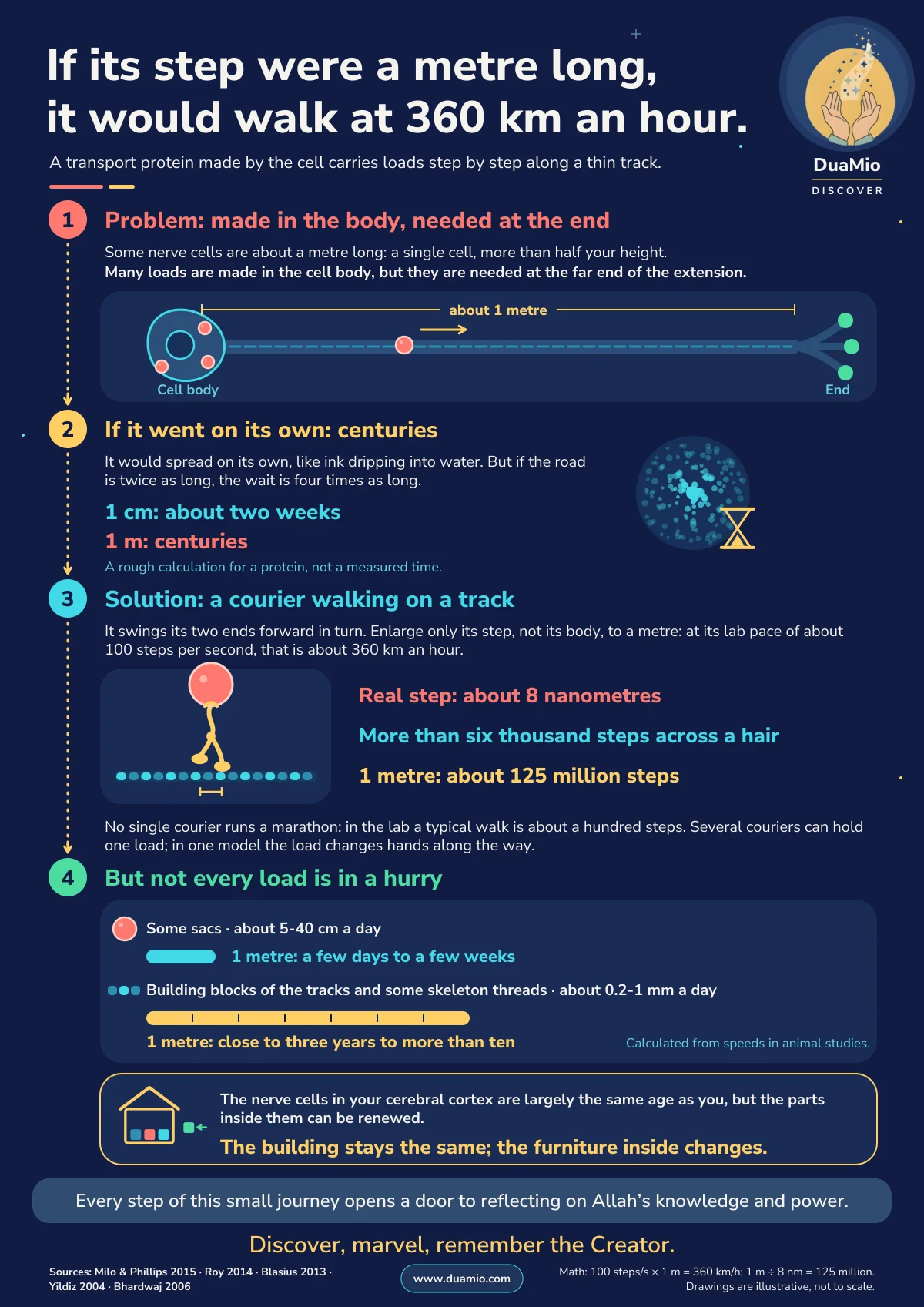
Download the high-quality infographic
Print-ready PDF in A4 and A3 sizes.
Free, with no sign-up required. Use it at home or in the classroom.
Sources and notes
The text and the reflection are DuaMio’s original work. In the plain language of the article, the walking carrier is kinesin-1, the example of a carrier moving in the opposite direction is dynein, the track is a microtubule, the track’s building block is tubulin, the long nerve extension is the axon, the energy molecule is ATP, the energy-producing compartment is the mitochondrion, and the skeleton thread is the neurofilament. “Two feet” is an analogy for the motor’s two heads that bind to the track.
Method note: The step scale is 8 nm → 1 m, a factor of 125 million. 800 nm/s ÷ 8 nm ≈ 100 steps/s; with the enlarged step, 100 m/s = 360 km/h. This is not a calculation for a body enlarged to human size. At the same ratio, a one-metre road becomes 125 million m, or 125,000 km; since the Earth’s equatorial circumference is 2π × 6,378 km ≈ 40,075 km, the ratio is ≈ 3.1. Taking the thickness of a hair as about 0.05-0.1 mm (a common assumption, not a measured value), 6,250-12,500 steps fit across it. A typical walk of about 100 steps is 800 nm, less than a thousandth of 1 mm. One metre is more than half of a height of about 1.7 m. Four metres ÷ 1.7 m ≈ 2.4 adult heights. One million connections ÷ 365 days ≈ 2,740 years; this calculation only conveys the size of the number. The 125 million steps in one metre are a geometric total, not the uninterrupted walk of a single motor. Diffusion time is roughly estimated with τ ≈ x²/(6D); the factor 6 is for three dimensions, and the source says to use 2 in one dimension. Taking D ≈ 10 µm²/s for a protein inside a cell gives about 1.7 × 10⁶ s for 1 cm; the source rounds this to 10⁶ s, or about two weeks. Because the time grows with the square of the distance, 1 m takes about 10,000 times as long as 1 cm, that is, hundreds of years. Inside a long extension, diffusion is almost one-dimensional; the time is then about three times longer, so the “centuries” in the text is a lower estimate.
Speed ranges vary with the source and the load group. Roy 2014 gives 50-200 mm/day for fast transport in the main text and a wider 50-400 mm/day in figure 1; the article uses the wider range. One metre ÷ 50-400 mm/day = 2.5-20 days. Converted to days, the laboratory and living-cell speeds give 800 nm/s ≈ 69 mm/day and 2,000 nm/s ≈ 173 mm/day; both fall within this range. In the same review, some skeletal proteins move at about 0.2-1 mm/day and the other slow group at about 1-10 mm/day. One metre ÷ 1 mm/day = 1,000 days ≈ 2.7 years (fast end of the range); one metre ÷ 0.2 mm/day = 5,000 days ≈ 13.7 years (slow end). The article gives both ends; these are example calculations, not times for all loads. Applying speeds from animal experiments to a one-metre human extension does not mean that a single load has been followed for years in humans.
In Yildiz 2004 the motor advances about 8.3 nm; the jump of the marker on one head is 17.3 ± 3.3 nm, with a position precision of about 2 nm. The four metres and one million connections in Pissadaki and Bolam are an estimate extending rat data to humans; the total branch network is not the path of a single load. According to Bhardwaj 2006, nerve cells in the cerebral cortex are generated around birth; new generation in adulthood was not found at a level that the methods used could detect.
- Yildiz, Tomishige, Vale and Selvin, 2004. Kinesin walks hand-over-hand. Science 303(5658):676-678. DOI 10.1126/science.1093753. Alternating advance of the motor heads and the jump of the marker on one head.
- Milo and Phillips, 2015. Cell Biology by the Numbers, Garland Science. How fast do molecular motors move on cytoskeletal filaments? Speed, step, average uninterrupted walk, several motors holding one load at once, and the opposing-force experiment.
- Milo and Phillips, 2015. Cell Biology by the Numbers, Garland Science. What are the time scales for diffusion in cells? Diffusion and distance calculation for a protein.
- Coy, Wagenbach and Howard, 1999. Kinesin takes one 8-nm step for each ATP that it hydrolyzes. Journal of Biological Chemistry 274(6):3667-3671. DOI 10.1074/jbc.274.6.3667. Coupling of steps and energy under low load in the laboratory.
- Visscher, Schnitzer and Block, 1999. Single kinesin molecules studied with a molecular force clamp. Nature 400(6740):184-189. DOI 10.1038/22146. In the laboratory, a rising load lowers the top speed; one energy molecule per step.
- Sleigh, Rossor, Fellows, Tosolini and Schiavo, 2019. Axonal transport and neurological disease. Nature Reviews Neurology 15(12):691-703. DOI 10.1038/s41582-019-0257-2. Gene changes in the transport machinery and nerve diseases; the cause-and-effect debate.
- Pissadaki and Bolam, 2013. The energy cost of action potential propagation in dopamine neurons: clues to susceptibility in Parkinson's disease. Frontiers in Computational Neuroscience 7:13. DOI 10.3389/fncom.2013.00013. Computational model of a rat dopamine neuron; energy cost of the electrical message and an estimate of the human branch network from rat data.
- Roy, 2014. Seeing the unseen: the hidden world of slow axonal transport. Neuroscientist 20(1):71-81. DOI 10.1177/1073858413498306. Fast and slow transport classes, figure 1.
- Roy, Coffee, Smith, Liem, Brady and Black, 2000. Neurofilaments are transported rapidly but intermittently in axons: implications for slow axonal transport. Journal of Neuroscience 20(18):6849-6861. DOI 10.1523/JNEUROSCI.20-18-06849.2000. Movement and pausing in cell culture.
- Bhardwaj, Curtis, Spalding et al., 2006. Neocortical neurogenesis in humans is restricted to development. PNAS 103(33):12564-12568. DOI 10.1073/pnas.0605177103. Human cerebral cortex samples; detection limit of the methods.
- Hancock, 2014. Bidirectional cargo transport: moving beyond tug of war. Nature Reviews Molecular Cell Biology 15(9):615-628. DOI 10.1038/nrm3853. Motors moving in opposite directions, the tug-of-war model and co-dependence in many inhibition experiments.
- Baas, Deitch, Black and Banker, 1988. Polarity orientation of microtubules in hippocampal neurons: uniformity in the axon and nonuniformity in the dendrite. PNAS 85(21):8335-8339. DOI 10.1073/pnas.85.21.8335. Rat cells in culture; tracks aligned in one direction in the axon, mixed in the dendrite.
- Blasius, Reed, Slepchenko and Verhey, 2013. Recycling of kinesin-1 motors by diffusion after transport. PLoS ONE 8(9):e76081. DOI 10.1371/journal.pone.0076081. Experiments and a computational model in cultured mouse nerve cells and a nerve-like cell line; reuse of the motor, the load changing hands between motors, and the limit of return by diffusion over long distances.
- OpenStax. Anatomy and Physiology 2e, 24.1 Overview of Metabolic Reactions. The cycle of energy molecules.
- OpenStax. Anatomy and Physiology 2e, 12.4 The Action Potential. The electrical message along the nerve membrane.
- NIH MedlinePlus Genetics. What is a cell? How the cell makes proteins, and its internal compartments.
- NASA, Earth Fact Sheet. The Earth’s equatorial radius.