Hold a grapefruit in your hand. Feel its skin and its weight. It looks like one solid piece of fruit. Yet inside it are atoms far too small for your eyes to see. And those atoms are not tiny balls filled all the way through.
To picture their size, let us use an imaginary magnifying glass. We will travel from a piece of fruit to the Earth, then to a tiny marble in the middle of a stadium. Each step reveals something surprising about the familiar object in your hand.
If a grapefruit grew to the size of the Earth
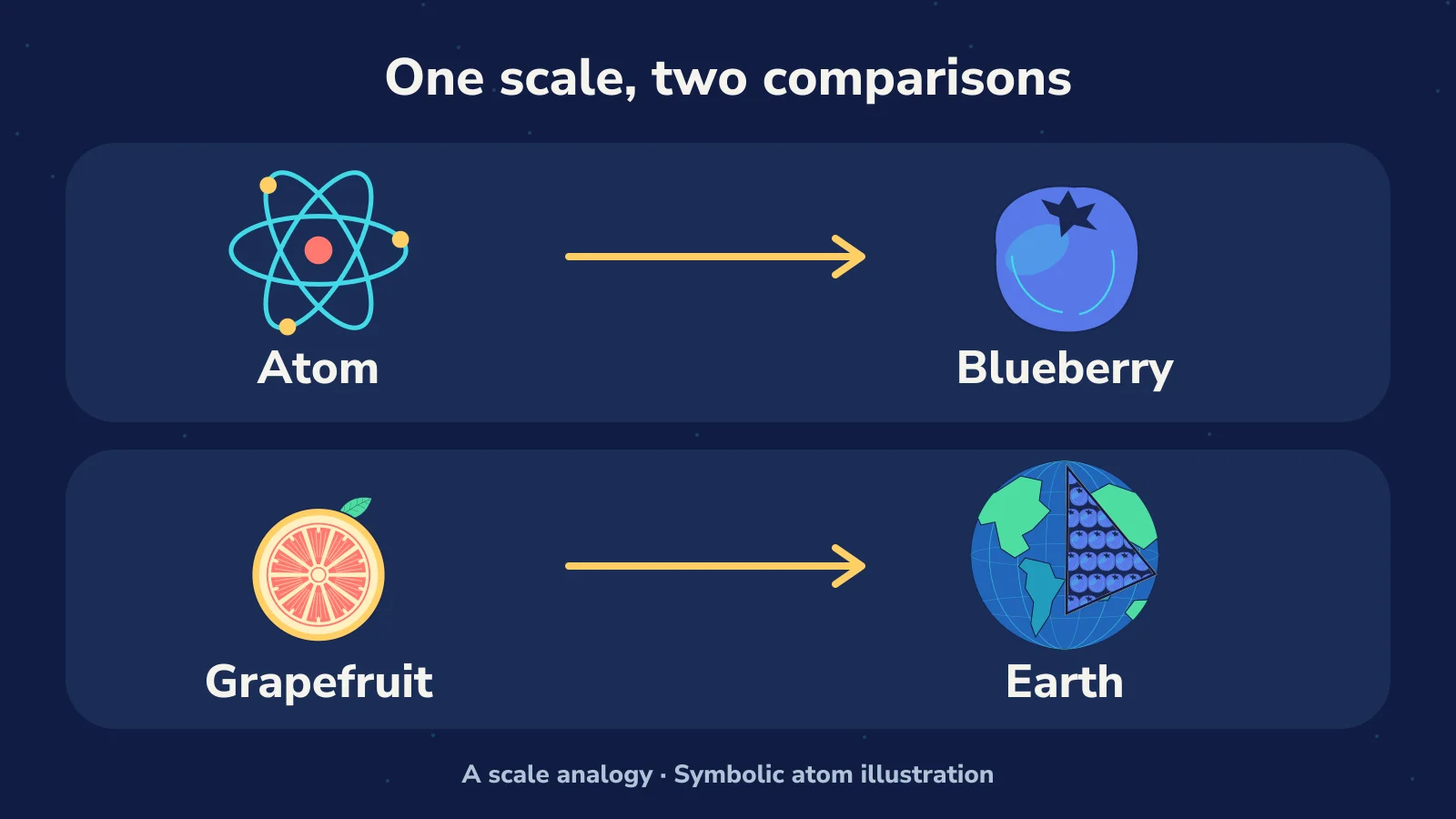
Imagine enlarging the atoms in a grapefruit until each was the size of a blueberry. Enlarged by the same factor, the grapefruit would be roughly the size of the Earth.
We are not just placing blueberries on the planet’s surface. Imagine filling its entire interior with them. This helps us begin to grasp how small the atoms in a piece of fruit are, and how many there must be.
The analogy uses a nitrogen atom as an example to make the comparison easier. A real grapefruit is not made only of nitrogen atoms. The sizes chosen for the fruit and the atoms also affect the result. This is a thought experiment that helps us understand differences in scale, rather than an exact scale model.
Now for a more surprising question: if an atom were the size of a blueberry, where would its nucleus be?
An entire stadium, a tiny marble
Even if an atom were the size of a blueberry, its nucleus would be very difficult to see. Keep enlarging it. When the atom reaches the size of a two-storey house, the nucleus might begin to appear as a tiny dot. When the atom is as big as a football stadium, picture its nucleus as a small marble in the middle.
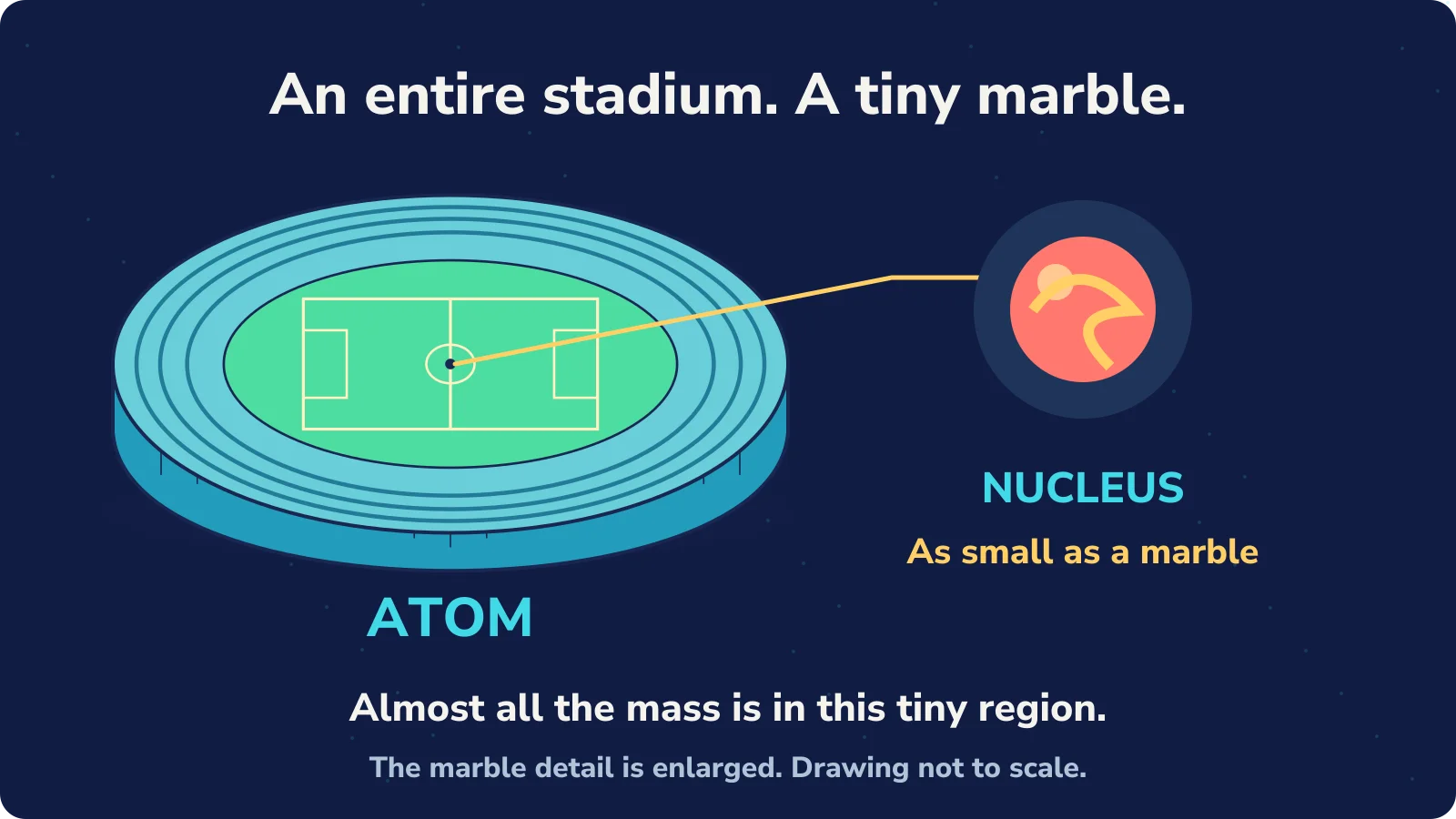
Look at the stands. Imagine the width of the pitch. Then focus on that little marble at the centre. Almost all of the atom’s mass is concentrated in that tiny region.
The nucleus contains positively charged protons. Most atomic nuclei also contain neutrons, which have no electric charge. The most common kind of hydrogen atom, for example, has no neutron in its nucleus. Electrons have mass too, but their contribution to the atom’s total mass is much smaller.
We draw the nucleus large so that we can recognise it. Its size on the page does not represent the fraction of the atom that it actually occupies. Recognising this difference between volume and mass is an important step towards understanding atoms.
What is in the rest of the stadium?
To understand the large region around the nucleus, we need to think about electrons. The particles in this region are not protons or neutrons; those are in the nucleus. Negatively charged electrons interact electrically with the positively charged nucleus and are bound within the atom.
But picturing electrons as little balls travelling along fixed paths, like planets around the Sun, is misleading. The modern atomic model describes where an electron may be found in terms of probabilities. We call this distribution an electron cloud. Here, “cloud” does not mean an actual mist.
Nor is the cloud always a perfect sphere. Different shapes arise depending on the electron’s state. An atom has no hard outer shell like a marble.
The number of electrons depends on the type of atom and its electric charge. A neutral nitrogen atom, for example, has 7 protons and 7 electrons. There is no single electron count that applies to every atom.
When we say that an atom is “mostly empty space”, we are describing how small its nucleus is compared with the atom’s volume. The surrounding region is not absolute nothingness: the electron distribution and electromagnetic fields are part of the atom’s behaviour. Electrons are not confined to the outer edge of the stadium.
Why does our hand not pass through a table?
When you press your hand against a table, the atoms in your hand and those in the table approach one another. Electrical interactions and the quantum rules obeyed by electrons prevent these structures from being compressed into one another without limit. As you push, you feel resistance.
One of these rules is the Pauli exclusion principle: two electrons cannot share the same state with all their quantum properties identical. A quantum state describes the electron’s physical condition, including more than just its location. As a starting point, you can think of the principle as preventing all electrons from simply piling into one identical state. The principle is not a separate classical force; it constrains which states electrons can share.
The solidity of matter therefore cannot be explained solely by imagining fully packed pieces colliding. Atomic bonding, electrical interactions and quantum rules all play a part. Differences in structure and bonding also help explain why materials differ in hardness.
Here is the surprising part: a table that feels full and continuous has a very different structure at the atomic scale. The solidity we experience in everyday life emerges from an order that our eyes cannot see.
How dense is the nucleus?
We have seen that the nucleus is very small, while much of the atom’s mass is concentrated there. Density connects these two facts: it tells us how much mass there is in a given volume. Density and hardness are not the same thing.
Now imagine a cube with sides of 30 centimetres. Suppose it were filled with matter at a nuclear density chosen for this example. If we take each car to have a mass of approximately 2 metric tonnes, the mass in the cube would correspond to that of roughly 5.4 trillion cars.
The short calculation is 5.4 trillion cars × 2 tonnes = 10.8 trillion tonnes. That is approximately 1.08 × 10¹³ tonnes. We are imagining all this mass inside a cube only 30 centimetres across on each side.
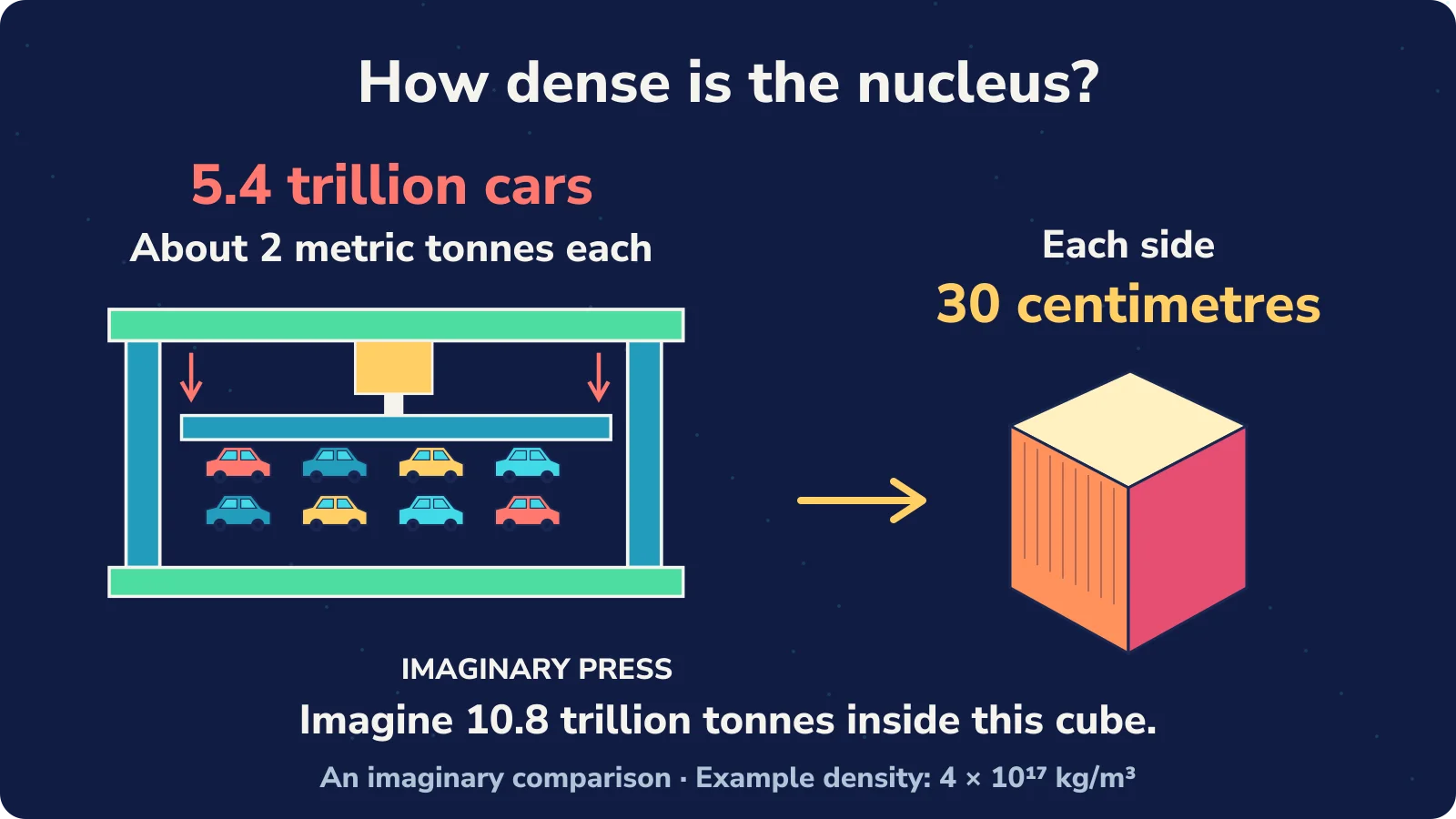
This result uses an assumed nuclear density of 4 × 10¹⁷ kilograms per cubic metre. The density depends on the model used; this value is not an exact, unchanging constant for every nucleus. Choosing a different density changes the equivalent number of cars.
Imagine gathering the mass of all those cars into that little cube with an imaginary press. This imaginary comparison helps us understand just how dense a nucleus is. The cube is not an actual atomic nucleus: we are applying nuclear density to a volume whose dimensions we can show with our hands.
The stadium and marble help us picture a difference in size; the cube and cars help us picture density. The two comparisons reveal different properties of the same structure.
What does this order remind us of?
The grapefruit is still in your hand. Its skin, scent and weight have not changed. What has changed is your perspective: you now know that within it is a structure made up of tiny nuclei and extensive electron distributions.
For a believer, this knowledge opens a way to reflect on Allah’s knowledge, will and power. Learning about proportion and order deepens our attention to creation. The Qur’an’s invitation to reflect on the creation of the heavens and the Earth provides a religious foundation for this reflection.
Physics investigates how atoms behave. Spiritual reflection is the thought we bring to that knowledge through our faith. An atomic calculation is not a measurement of a religious claim. Remaining faithful to the scientific explanation does not diminish our wonder at creation; it gives that wonder a sound basis.
You can remember this unseen order while holding a piece of fruit, touching a table or looking at a drop of water. We do not need to wait for grand landscapes to feel grateful. A piece of fruit that fits in our hand can also awaken our attention.
Even in an atom we cannot see, there is such remarkable order. Reflect on the infinite knowledge and power of Allah, who created it.
Discover with wonder. Remember the Creator.
Infographic and downloads
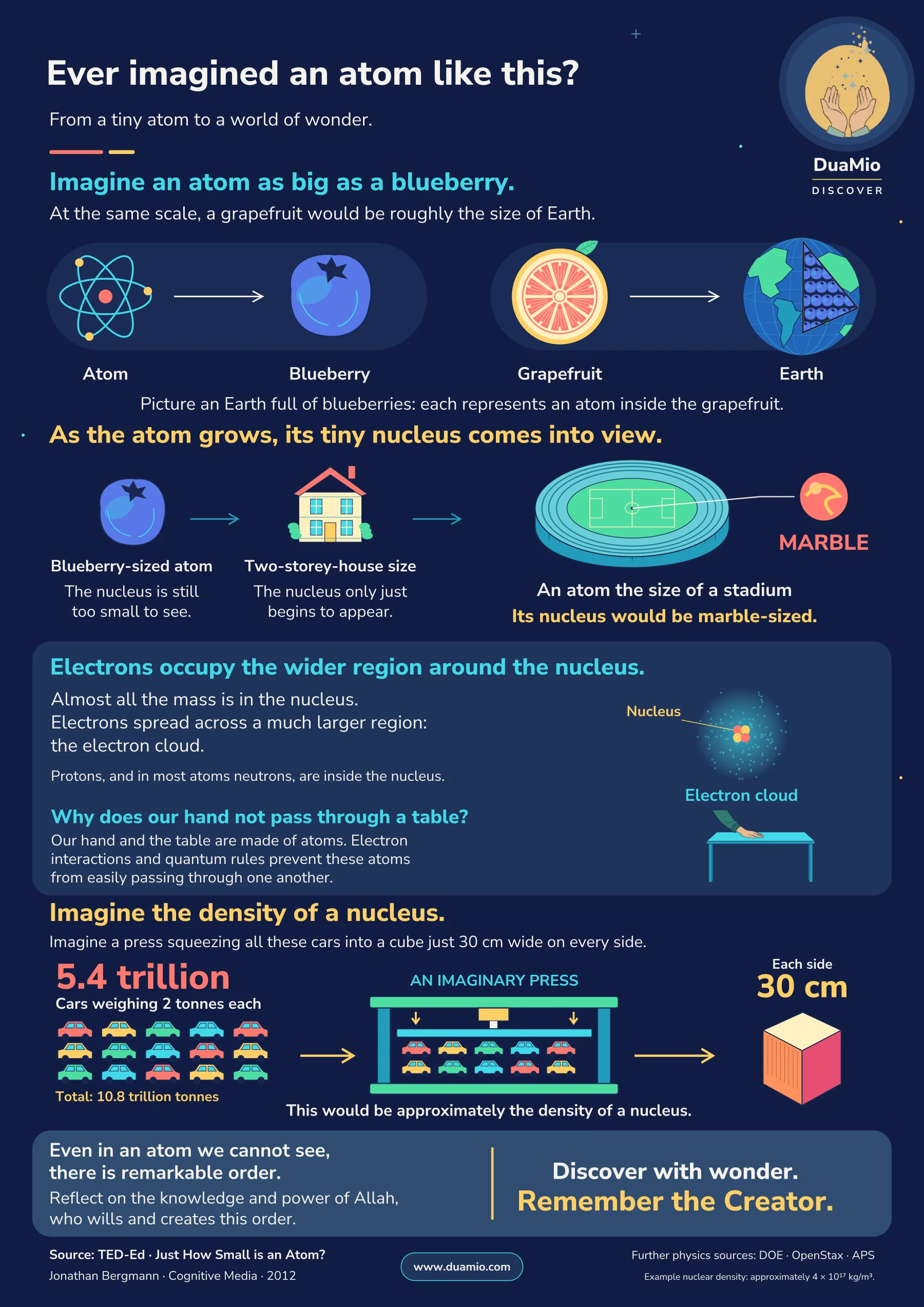
Download the high-quality infographic
Print-ready vector PDFs and the original high-resolution PNG in a ZIP file.
Free, with no sign-up required. Use it at home or in the classroom.
Sources and notes
The starting point for the scale analogies is TED-Ed, “Just How Small is an Atom?”: Jonathan Bergmann; animation: Cognitive Media / Andrew Park, 2012. The text, illustrations and spiritual reflections are DuaMio’s original work. This article is neither a transcript nor a word-for-word translation of the video; the religious reflections do not originate from the source video.
- TED-Ed: original lesson and contributor information
- TED: publication and Cognitive Media credit
- US Department of Energy: nuclei and electrons.
- OpenStax: nuclear properties and density model; molecular bonds.
- American Physical Society: the role of the Pauli principle in the stability of matter.
- Royal Society of Chemistry: properties of nitrogen; NASA: the Earth’s dimensions.
- Qur’an 3:190-191: Saheeh International translation.
- Diyanet: Qur’an 3:190-191, Turkish translation and commentary.
Scale note: For example, a grapefruit roughly 10 cm across, a blueberry 1.8 cm across and an approximate atomic diameter of 0.14 nanometres derived from nitrogen’s covalent radius bring us close to the Earth’s scale. For nitrogen-14, an atom represented as roughly 200 metres across would have a nucleus of about 8 millimetres. The definition of atomic size and the chosen dimensions affect the result; the drawings are not to scale.
Calculation note: The cube’s volume is 0.30³ = 0.027 m³; the example mass is 4 × 10¹⁷ × 0.027 = 1.08 × 10¹⁶ kg; the equivalent number of 2,000 kg cars is 5.4 × 10¹². This result depends on the selected approximate assumptions. OpenStax’s simple nuclear model gives a density of about 2.3 × 10¹⁷ kg/m³; that assumption gives approximately 3.1 trillion cars for the same cube. The article and infographic use the same 30 cm / 2 metric tonnes / 4 × 10¹⁷ example.