How many red blood cells are in a drop of blood?
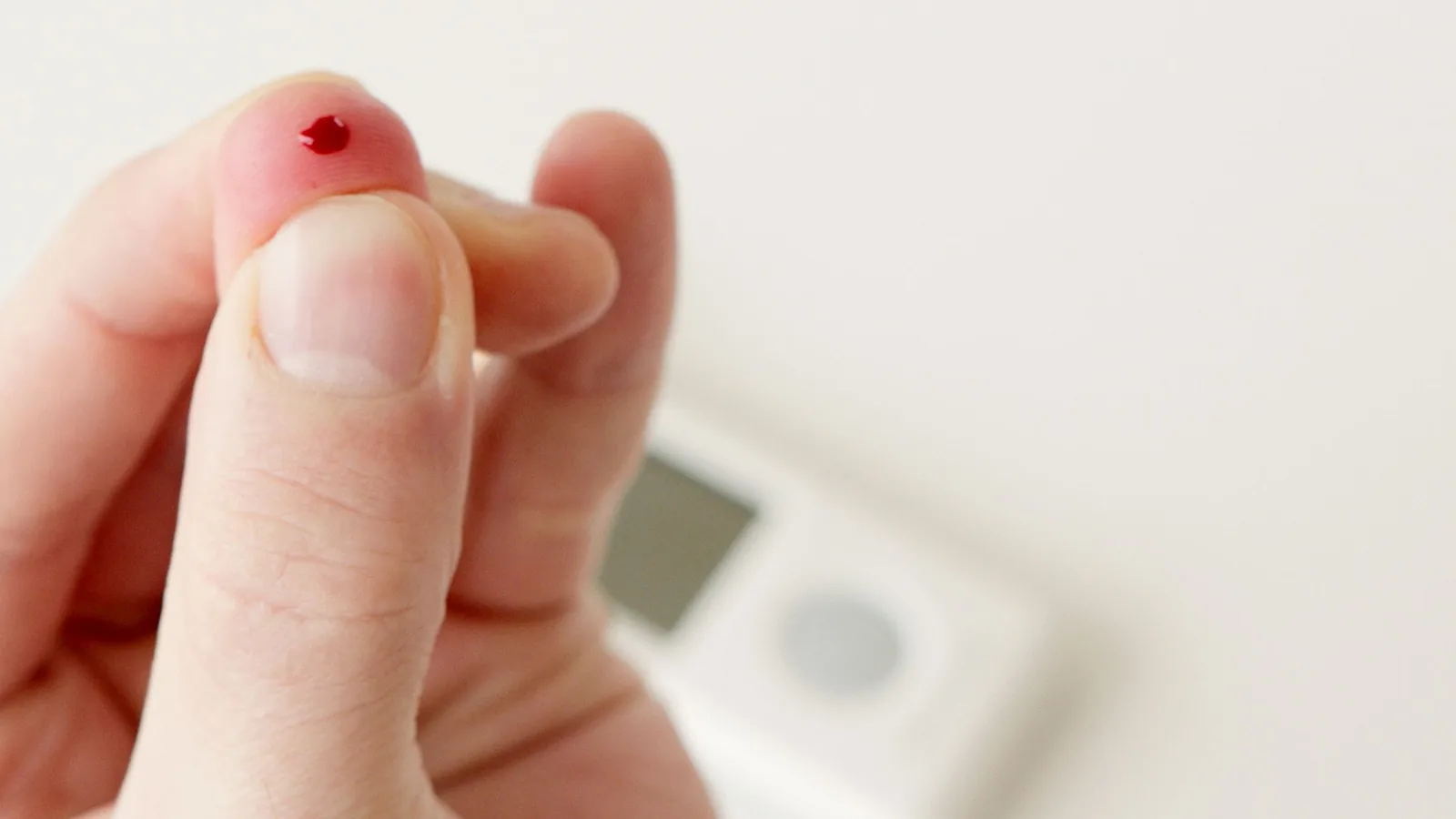
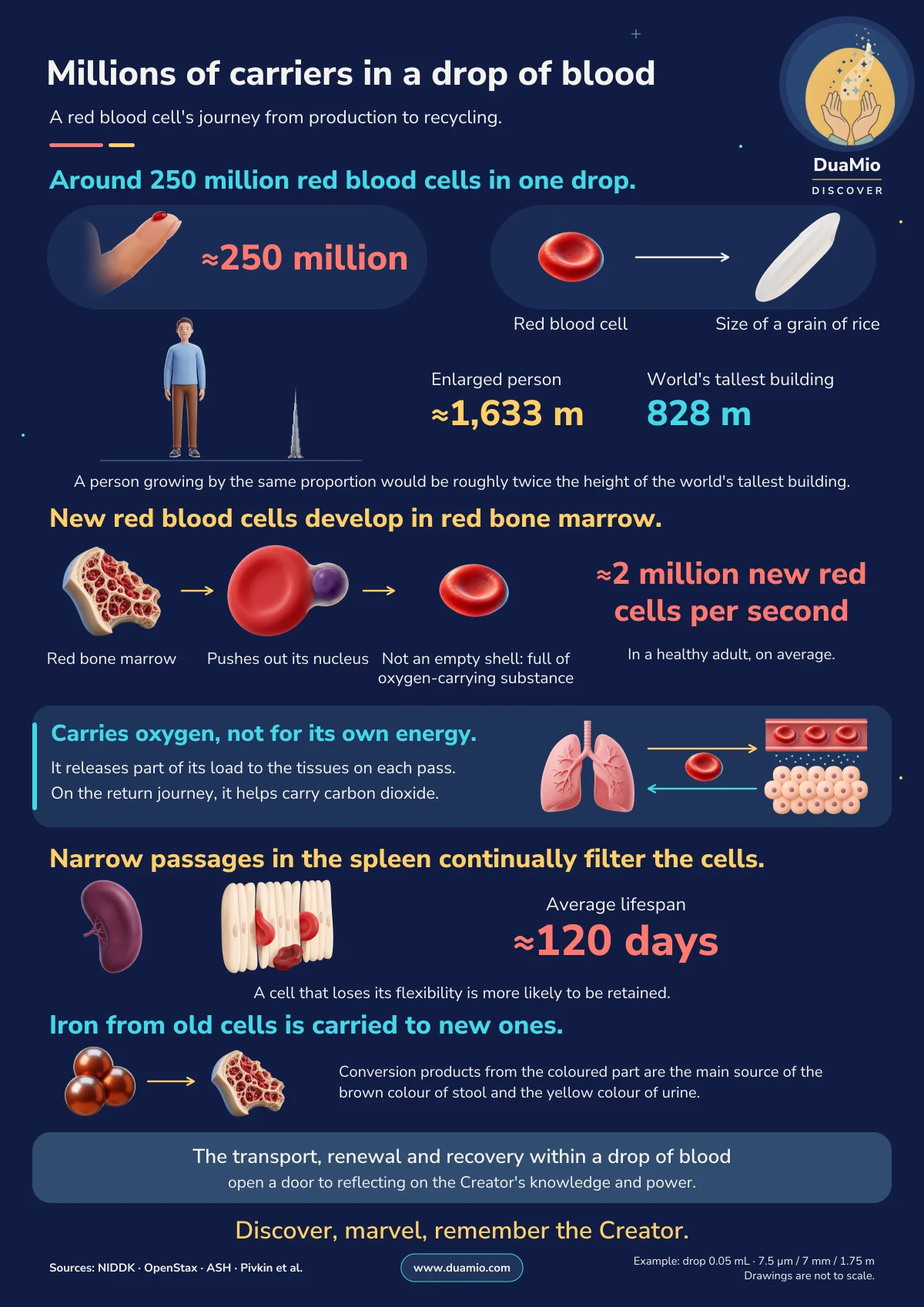
Think of a tiny drop of blood appearing on your finger. A drop like this can contain around 250 million red blood cells. Your eyes see only a red drop; inside it are millions of cells carrying oxygen.
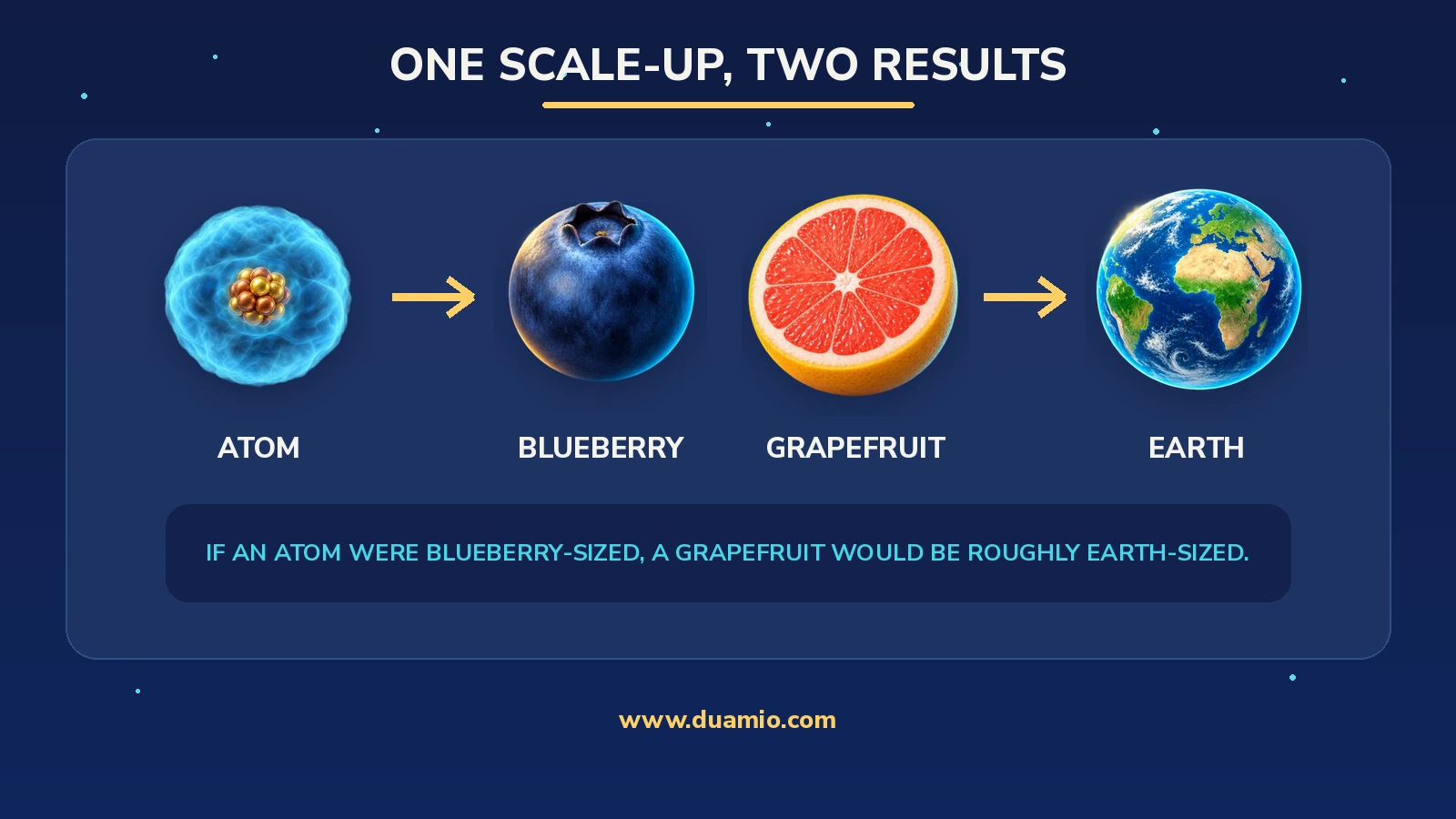
Imagine enlarging one red blood cell to the size of a grain of rice. If you grew by the same proportion, you would be more than one and a half kilometres tall: roughly twice the height of the world's tallest building. At that size, the cell would still be a grain of rice resting in your palm.

≈250 millionred blood cells in one small drop


These tiny carriers do not stay with you unchanged throughout your life. Your body continually replaces them. Their production site is not your heart or your lungs, but the inside of your bones.
A living factory works inside hard bone
We tend to think of bones as a hard framework that holds us upright. Yet they also contain soft, living tissue supplied with blood vessels: bone marrow. The part that produces blood cells is red bone marrow.
In adults, production is concentrated in the pelvis, vertebrae, ribs and breastbone. Even as you sit there, new cells that will enter your blood are developing inside your hip bones.
Different pathways begin with the blood-forming stem cells there. One leads to red blood cells, others to defence cells and the tiny fragments that help blood clot. The same starting point, different jobs. A red blood cell's main job is to carry the oxygen you breathe in to your tissues.
In a healthy adult, around two million new red blood cells enter the bloodstream every second. A ten-second wait means around twenty million new carriers. This does not mean that a single cell is made in one second; many cells at different stages of development keep production going together.


≈2 million new red blood cells per secondIn a healthy adult, on average.
A red blood cell sheds its nucleus as it matures
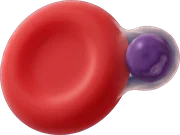
A developing human red blood cell has a nucleus. This part, which carries genetic information, is pushed out of the cell during the final stages of maturation. The young red blood cell continues to mature after entering the circulation.
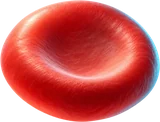
What remains is not an empty shell. The cell is filled with a substance that can bind oxygen. Its shape is not a marble either, but a disc with a shallow depression on each side and thicker edges.
Losing the nucleus and many internal components leaves more room for the oxygen-carrying substance. The absence of a nucleus makes it easier to fit through narrow passages; the flexible membrane and the protein network supporting it from within also help the cell bend and regain its shape. One tiny cell must both carry a load and pass through the narrowest blood vessels.
The mature red blood cell has also lost the internal components that use oxygen to produce energy. It obtains its energy through a pathway that does not require oxygen. This means it does not consume the oxygen it carries to meet its own energy needs. Like a truck that does not burn its cargo as fuel for its own engine.
There is a limit to this: a mature red blood cell cannot divide or produce new proteins. When it wears out, a new one must take its place. That is why production in the bone marrow cannot simply stop and wait.
How do researchers observe this transformation?
The nucleus leaving the cell is not just an illustration. Researchers have followed this transformation in human-derived cells in the laboratory using microscope images taken at intervals. The successive frames reveal the expelled nucleus and the cell left behind.
This imaging is also used to investigate the production of red blood cells in the laboratory. In one study, researchers examined how different compounds affected the expulsion of the nucleus. Obtaining more cells without nuclei was not enough on its own; the strength of the resulting cells' membranes also mattered. Researchers are trying to understand both maturation and how the cell stays intact.
These are cells under specialised laboratory conditions; they do not represent the whole body. Even so, they show something concrete: preparing for the carrying task involves more than removing the nucleus. The cell must also remain intact along the way.
A red blood cell passes through vessels narrower than itself
After entering the bloodstream, a red blood cell picks up oxygen from your breath in the lungs. It travels to the tissues in the blood pumped by your heart. In some parts of the route, a capillary is narrower than the cell's own diameter.
A hard marble would not fit. A red blood cell, however, bends, stretches and squeezes through the narrow passage. Afterwards, it regains its shape. These large changes in the shape of human red blood cells have also been studied in laboratory microchannels.

Its shape, with a depression on both sides, provides a large surface for gas exchange. Its flexibility also allows it to carry its load into the smallest vessels. Form and function meet in the same tiny cell.
Oxygen diffuses into tissues on its own
A red blood cell does not leave the blood vessel to hand a package to another cell. Oxygen diffuses from the blood into the tissues. The direction of movement is determined by the difference in the oxygen conditions on the two sides.
Cells in the tissues consume oxygen as they work. This consumption helps maintain the difference that keeps oxygen diffusing from blood to tissue. Like a drop of ink spreading through a glass of water, oxygen's passage does not involve a molecule deliberately choosing a door.
The oxygen-binding substance releases part of its load under the conditions in the tissues. Rising carbon dioxide levels and greater acidity make release easier. The entire load is not unloaded on each pass; blood returning to the lungs still contains oxygen. Transport continues according to demand and the surrounding conditions.
A red blood cell also helps on the return journey
Working cells produce carbon dioxide. This time, the gas moves from the tissues into the blood and is carried to the lungs. It leaves the body when you breathe out.
A helper substance inside the red blood cell speeds up the conversion of much of the carbon dioxide into another form that is easier to carry in the blood. The conversion happens inside the red blood cell; most of the resulting substance travels in the liquid part of the blood. In the lungs, the process reverses and carbon dioxide is released as a gas again.
The same cell carries oxygen on the outward journey and helps remove carbon dioxide on the return. But not all the body's waste takes this route. The kidneys filter other wastes from the blood and remove them in urine.
Narrow passages in the spleen continually filter red blood cells
A red blood cell lives for an average of 120 days. This is not an alarm that rings on the same day for every cell. The cell wears down as it works in the circulation; the body's filtering system operates throughout its life.
Narrow passages inside the spleen test the ability of cells passing through them to change shape. A cell that retains its flexibility can pass. A cell whose shape has changed or that cannot bend enough is more likely to be retained.
Age is not the only thing that matters here. The cell's shape, size and flexibility are important. Certain changes in its membrane also help the scavenger cells recognise it. There is no single, perfect death label that explains the removal of every ageing red blood cell; several signals play a part together.
Scavenger cells, mainly in the spleen and liver, take in and break down the red blood cells marked for removal. A carrier too worn out to work becomes a source of material for new production.
How do new red blood cells replace the old ones?
As the bone marrow continually produces new red blood cells, worn-out cells are removed from the circulation. In a healthy body in balance, the new cells entering the blood and the old cells being removed roughly balance out over time. Continuous production therefore does not mean that red blood cells build up without limit.
This balance is not a counter that produces and breaks down exactly the same number of cells every second. Production changes with the body's needs. What matters is that renewal makes up for losses over the longer term.
The main signal that adjusts production comes from the kidneys. When the oxygen reaching the kidneys is insufficient, a messenger substance increases; it stimulates red blood cell production in the bone marrow. As the oxygen need is met, this signal decreases; it does not have to stop altogether.
Taking in less oxygen at high altitude is one example in which this relationship can be observed. The body takes time to adapt; increased production contributes to oxygen transport. The air, kidneys and bone marrow connect to different parts of the same need.
When the balance is disturbed and red blood cells or their oxygen-binding substance are insufficient, oxygen delivery to the tissues can be impaired; fatigue or shortness of breath may occur. The work of these tiny carriers is felt in the energy of everyday life.
Where does the material from a broken-down red blood cell go?
The iron inside a red blood cell is not thrown away and forgotten. It is recovered from the centre of the oxygen-binding structure, binds to a carrier in the blood and travels to the bone marrow to be used in making new cells. Iron carrying oxygen today may previously have served in another red blood cell.
The protein part is also broken down into building blocks and reused. The old cell's task ends, but some of its material continues working inside the body.
The coloured part left after the iron is removed follows a different route. It is processed in the liver and sent to the intestine in bile. Products formed by its conversion in the intestine are the main source of the brown colour of stool. Some of these conversion products are reabsorbed into the blood; the coloured products removed in urine are also the main source of its yellow colour.
One trace of your body's daily renewal is hidden in these ordinary colours. Production in the bone marrow, transport in the circulation and processing in the liver are not disconnected tasks.
How much organisation lies behind a single breath?
A breath takes a moment. But forming the cell that will carry its oxygen, keeping that cell flexible, releasing its load and passing its place to a new one depend on a system that works continuously. While production continues in one place, old material is recovered in another.
Learning about these connections deepens the way we see our bodies. Through DuaMio's window of reflection, this renewal beyond our sight opens a door to thinking about Allah's knowledge and power. Wonder can grow in a drop of blood as much as in a distant sky.
Your next breath is another moment in this quiet work that begins inside your bones.
Discover, marvel, remember the Creator.
Infographic and PDF downloads
Download the high-quality infographic
Print-ready PDF in A4 and A3 sizes.
Free, with no sign-up required. Use it at home or in the classroom.
Sources and explanations
The text and reflective narrative are DuaMio's original work. The oxygen-binding substance described in everyday language is hemoglobin; the helper that speeds up carbon dioxide conversion is carbonic anhydrase; the iron-carrying protein is transferrin; the messenger from the kidneys is erythropoietin; and the coloured conversion products are stercobilin and urobilin.
Method note: In the drop example, assuming 0.05 millilitres of blood and around 5 million red blood cells per microlitre gives around 250 million cells. Drop volume and cell concentration can vary. The enlargement example assumes a red blood cell diameter of 7.5 micrometres, a rice grain length of 7 millimetres and a human height of 1.75 metres. The enlargement is around 933-fold; the human height becomes around 1,633 metres. The comparison assumes a building height of 828 metres. These are thought experiments that help convey scale, not a person's blood count or height measurement. Around two million per second is an average renewal rate in a healthy adult; 120 days is an average cell lifespan. Approximate rates, lifespans and total cell counts from different sources have not been combined as though they were a single measurement from the same person.
- NIDDK, Recent Advances 2019, p. 90: around two million new red blood cells enter the circulation each second in a healthy adult
- OpenStax, Anatomy and Physiology 2e, Erythrocytes: diameter of 7-8 micrometres, expulsion of the nucleus, shape, average lifespan of 120 days, breakdown in the spleen and liver, recovery of iron, and pigments in stool and urine
- National Cancer Institute, Bone marrow: the distinction between red and yellow bone marrow
- NCI SEER Training, Introduction to Blood: the origin and production of blood cells
- Soboleva et al., 2021, Communications Biology. DOI: 10.1038/s42003-021-02202-1: imaging the expulsion of the nucleus in human-derived cells
- Quinn et al., 2011. DOI: 10.1007/s10439-010-0232-y: red blood cells changing shape to pass through narrow channels
- NHLBI, What Breathing Does for the Body: oxygen transport from the lungs to tissues
- OpenStax, Gas Exchange: the gradient and oxygen consumption in tissues
- OpenStax, Transport of Gases: oxygen release and forms of carbon dioxide transport
- American Society of Hematology, Blood Basics: average lifespan, bone marrow and stimulation of production by the kidneys
- Pivkin et al., 2016, PNAS. DOI: 10.1073/pnas.1606751113: mechanical filtering by the human spleen; computational models and comparison with experiments on the human spleen
- Seki et al., 2020, Journal of Cellular and Molecular Medicine. DOI: 10.1111/jcmm.16010: membrane changes in ageing red blood cells; no single, universal clearance signal is claimed
- NIDDK, Erythroferrone: a regulator of iron balance: recovery and reuse of iron from old red blood cells
- MedlinePlus, Bilirubin blood test: removal through bile of the yellow substance produced when old red blood cells break down
- NIDDK, Your Kidneys & How They Work: filtering waste from the blood in the kidneys