Short Answer
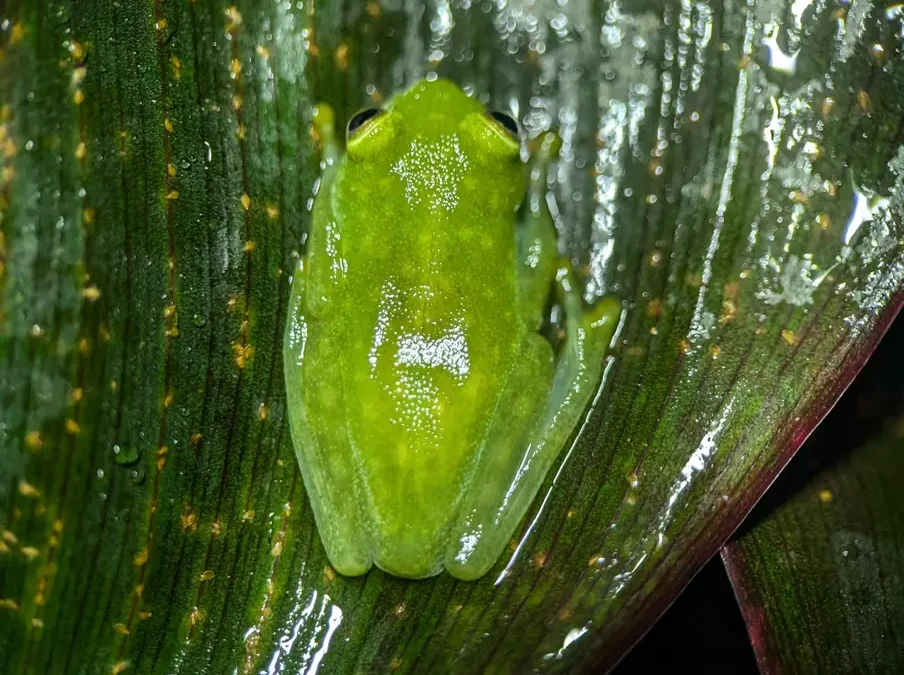
The glass frog is a small tree frog — just a few centimetres long — whose belly skin is transparent enough that you can see its heart beating, its intestines coiling, even its pulsing blood vessels from the outside. During the day it rests motionless on the underside of a leaf and becomes nearly invisible. The most surprising reason for this was only understood in 2022: while sleeping, the frog withdraws roughly 89% of its red blood cells from circulation and packs them into its liver.
Why? Because the main obstacle to transparency in any vertebrate is blood. The red pigment in red blood cells absorbs light and makes the animal visible. When those cells are hidden, the remaining tissue becomes much clearer, and the frog’s transparency increases two to three times over. When it wakes and needs to move, the cells are released back into circulation.
One honest clarification upfront: on land the frog is not fully “invisible” — “semi-transparent” is more accurate. But the fact that this small creature can pack its own blood into a single organ for hours — without any clotting — and then release it again is a remarkable precision in itself.
Real observation video: you can watch the glass frog’s translucent body and how its internal structure appears in live footage.
What We Observe
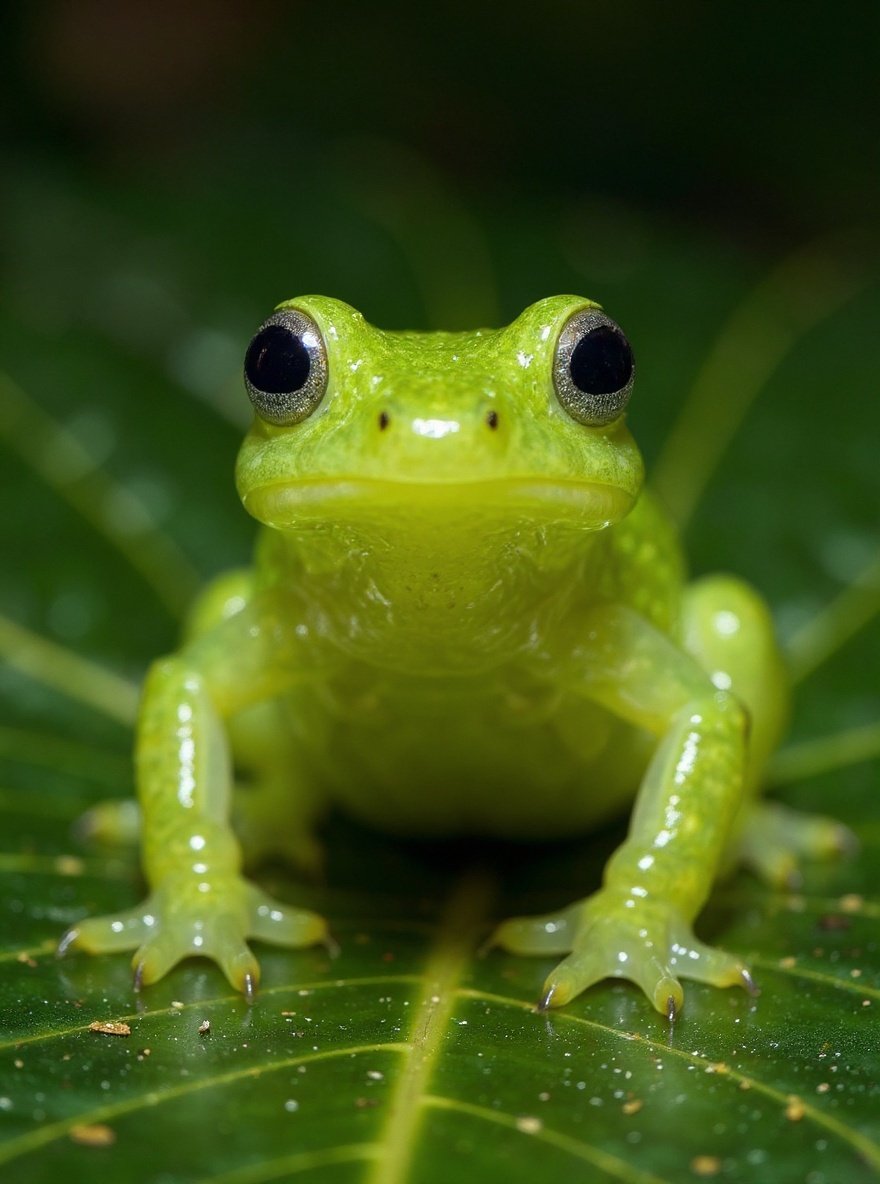
Hold a glass frog up to a light and you are looking at something that resembles a page from a biology textbook: the heart beats, the intestines coil. At night it is active and its green skin blends into leaf surfaces. Its true skill, though, is on display during the day. Clinging motionless to the underside of a leaf, the boundaries of its body simply dissolve.
The question that follows is a strange one: how can an animal “hide” its blood? In humans, blood circulates everywhere at all times — stopping or pooling it is dangerous. Yet in the glass frog, during rest, the bulk of the blood withdraws silently into a single organ and returns without any apparent harm.
The Scientific Mechanism
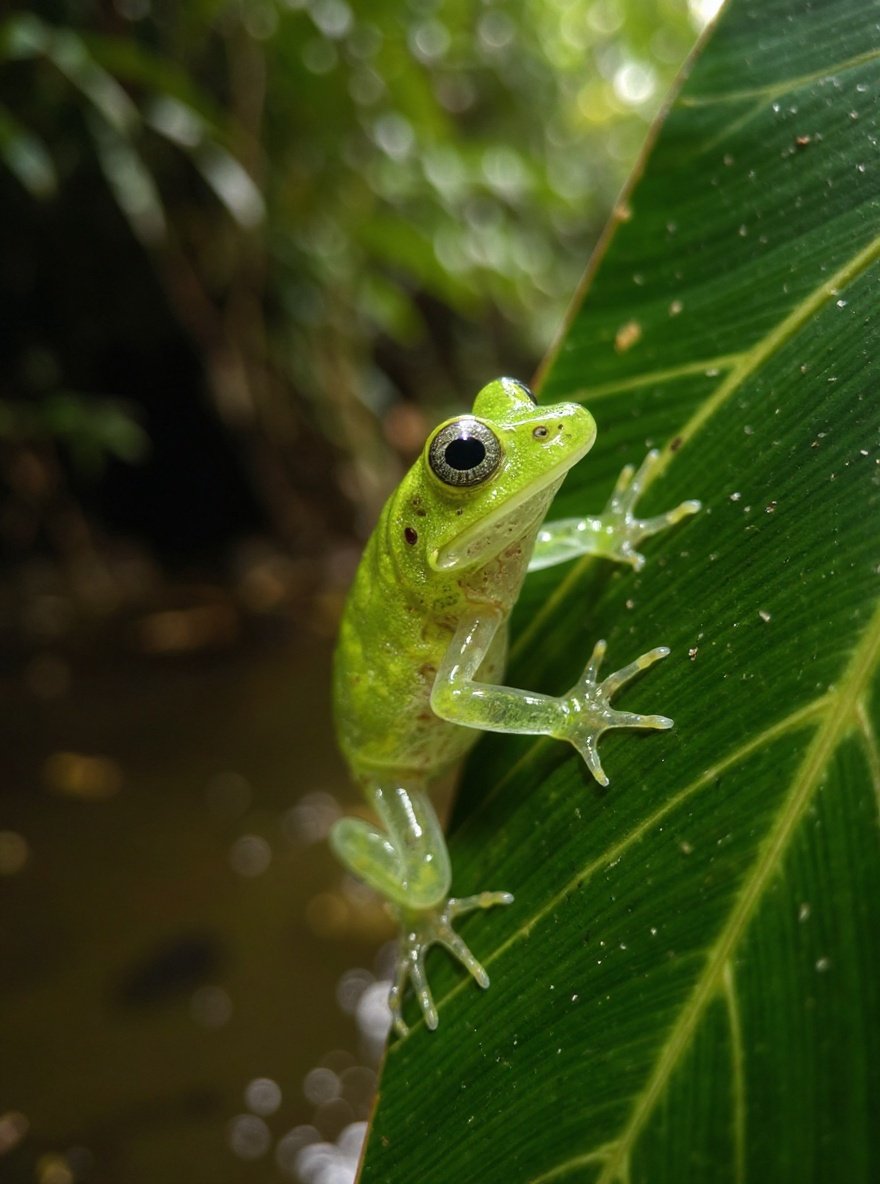
The answer was clarified in a 2022 paper in Science by Carlos Taboada, Jesse Delia, and colleagues. The team studied the northern glass frog (Hyalinobatrachium fleischmanni) using photoacoustic imaging — a method that uses light and sound waves to track red blood cells inside a living animal without causing any tissue damage.
The result was striking: when resting, the frog withdrew approximately 89% of its red blood cells from circulation and packed them into its liver. Red blood cells are the component that absorbs the most light in the body — the element most responsible for blocking transparency. Once packed into a single organ, the frog’s remaining tissues cleared and transparency increased two to three times. The surface of the liver acted like a mirror, reflecting light inward rather than letting the redness bleed outward.
The most surprising aspect: in humans, this degree of blood pooling in one location would cause fatal clotting. The glass frog keeps its red blood cells densely packed for hours and then releases them back into circulation with no clotting at all. Exactly how clotting is prevented remains a mystery; researchers say the mechanism could hold important clues for developing drugs against clotting disorders in humans.
One correction is also needed. A 2020 study in PNAS by Barnett, Cuthill, and colleagues showed that on land the glass frog is not fully transparent — “semi-transparent” is the right word. Scientists call this “edge diffusion”: the real camouflage is not complete invisibility but softening the silhouette so the body blends imperceptibly into the leaf.
The Wow Factor
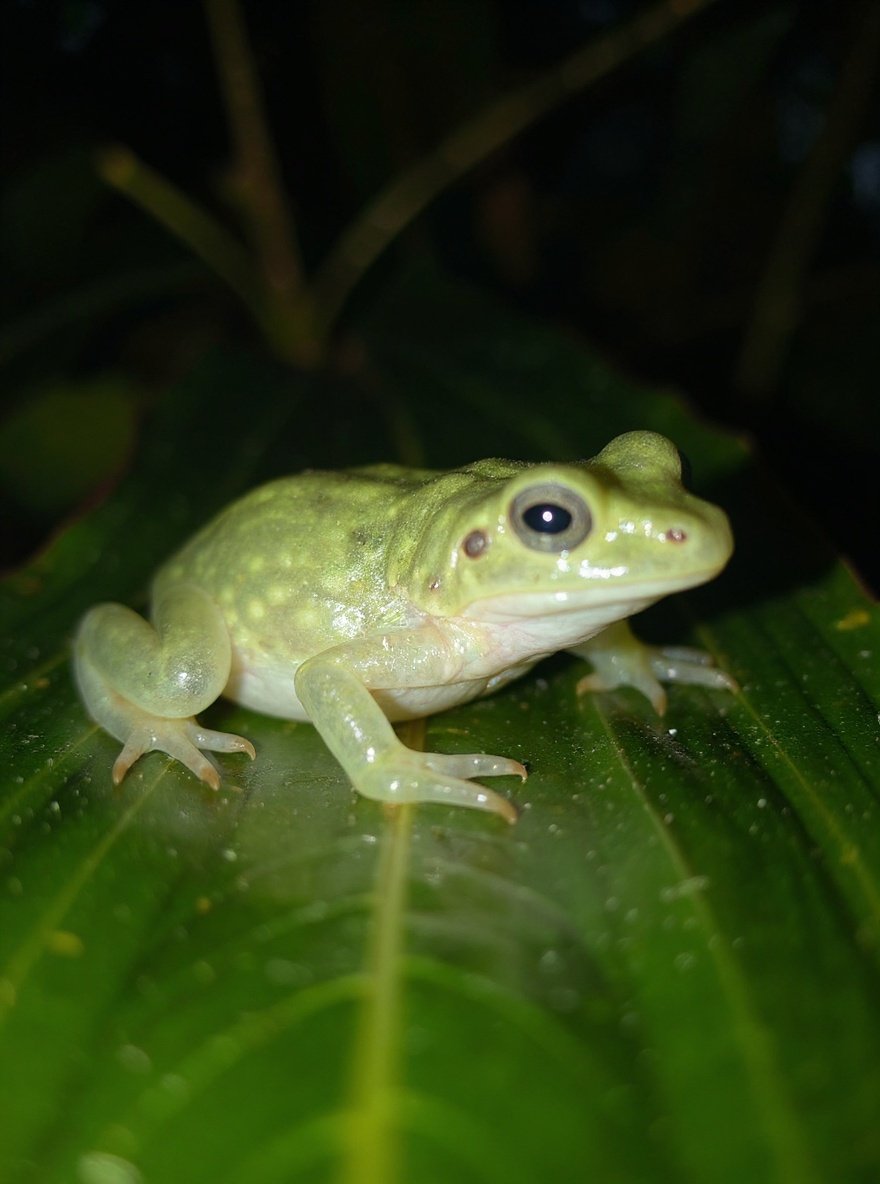
The truly surprising thing here is not that the frog “becomes transparent.” The remarkable part is this: two conflicting needs are met at the same time. To stay hidden, the blood needs to be concealed. To stay alive, that blood needs to keep carrying oxygen.
Nearly stopping circulation for hours and concentrating blood in a single organ would be catastrophic in any other animal: clotting, tissue death, oxygen deprivation. Yet in the system given to the glass frog, every one of these dangers appears to have been pre-empted — clotting suppressed, cells stored safely and recalled on demand. That so many “side effects” of a single behaviour are all resolved simultaneously carries the mark of precise measure, not random coincidence.
Hide the blood, stay invisible — but without clotting. Two opposing needs resolved in the same body at the same time.
Inspired by Nature
To be honest: saying “the glass frog inspired invisibility technology” would be an overstatement for today. There is no cloaking device or metamaterial that has been copied from this frog.
Instead, the value researchers themselves point to is medical. The glass frog’s ability to densely pack blood without clotting could inspire new drugs against vascular blockages and clotting disorders in humans. The photoacoustic imaging used in this study is itself a biomedical method for monitoring blood flow non-invasively, and it is seeing growing use in medicine.
The lesson here is not an “invisibility machine” — it is that a solution found in nature can open a door somewhere entirely unexpected, in this case human health. That is often how science advances: a precision observed in a living creature guides us somewhere we would not otherwise have looked.
Up Close
A researcher watching a glass frog under a photoacoustic device sees a choreography invisible to the naked eye: as the frog drifts into sleep, red points slowly withdraw from all over the body and collect toward the liver. The animal suddenly looks clearer, more “glassy.” When roused, the redness spreads back through the whole body within a few seconds.
This coming and going might seem unremarkable — but each time it requires red blood cells to gather at exactly the right moment, be stored in exactly the right place, and be released at precisely the right time without clotting. That such precise sequencing runs without fail, every day, through every sleep-wake cycle, gives pause when you look at it carefully.
A Window for Reflection
The glass frog is a helpless creature. It does not calculate where to store its blood or how much; it did not design the mechanism that prevents clotting; it did not coat its own liver with a light-reflecting surface. All of this was given to it — placed in its body beforehand. What we admire is not the frog’s cleverness; it is the fine design with which the frog has been endowed.
The Quran repeatedly invites us to observe the precise measure and balance (mīzān) in what surrounds us. What we see here is exactly that: two conflicting needs — to hide and to live — met in the same body without compromising each other. Perfection is not in the creature; it is in the measured design given to it, and the design belongs to its Creator.
Reflection is not saying “what a clever animal.” It is pausing to ask, quietly: “Who placed this precise measure inside something this small?” When we watch a glass frog grow transparent in its sleep, we are looking at a wisdom embedded in a humble creature — a quiet door that turns the gaze from the work to its Maker.
What It Tells Us Today
The glass frog reminds us that the hardest problems are sometimes solved not by elimination but by placement. The frog could not do without its blood; instead, when needed, it draws the blood to the right place and releases it at the right time. The obstacle is not removed — it is managed with elegance.
And seeing such fine order inside a creature no bigger than a thumb turns our attention not to our own greatness but to the wisdom of the One who arranged it.
Discover with wonder, remember the Creator.
Sources
- https://commons.wikimedia.org/wiki/File:Hyalinobatrachium_fleischmanni_418870647.jpg — Real source photograph used for the hero image (Wikimedia Commons).
- Taboada, Delia, Chen et al., Science, 2022 — ~89% of red blood cells packed into liver while sleeping; transparency increases 2–3×. Science · PMC9984244
- Cruz & White, Science, 2022 — “Lessons on transparency from the glassfrog.” Science
- Barnett, Cuthill et al., PNAS, 2020 — semi-transparency on land and edge diffusion camouflage. PNAS
- Duke Pratt School of Engineering, 2022. pratt.duke.edu
- PBS NewsHour, 2022. pbs.org
Coming soon
Listen to these topics in the app, track your progress.
In the DuaMio app you’ll listen to every topic — not to memorize, but to comprehend.
Image note: The hero image of this article is a real source photograph. The three in-article images were generated with AI from that real reference to illustrate the subject more clearly.
Content note: This article was compiled with AI assistance based on reliable scientific sources and editorially reviewed before publication.