
This question is often reduced to a single sentence: “In Islam, do two women count as one man?”
But the matter is not that simple. Because the relevant provision in the Qur’an is not a general ruling about a woman’s human worth; it is a specific measure concerning one legal area — commercial debt and financial records.
So to answer the question correctly, we must first separate two things: testimony is not a rank that measures a person’s worth. Testimony is a legal responsibility given so that a right is not lost.
Here the DuaMio Wisdom approach does this: first it clarifies the ruling, then it shows the context, then it carries the wisdom into language today’s reader can understand.
Short answer
No. Islam does not generally count a woman in court as “half of a man.”
The matter of two women being taken as witnesses together with one man appears only in Surah Al-Baqarah verse 282 (2:282), which concerns the recording of commercial debt and financial transactions.
In criminal law, family law, the reporting of religious news, matters specific to women, and the seeking of one’s rights, the picture is far broader. In some areas the testimony of a woman and a man is equal; in some areas even a single woman’s statement is accepted as valid and sufficient.
The real issue is not the woman’s worth, but the subject of the testimony, the person’s experience in that field, legal reliability, and the protection of the right.
The ruling layer: not an absolute rule, a specific area
In Islamic law, treating two women’s testimony as equal to one man’s is not an absolute and universal rule. This ruling concerns, in particular, material and commercial transactions. Surah Al-Baqarah verse 282 (2:282) regulates witnessing when a debt is put into writing:
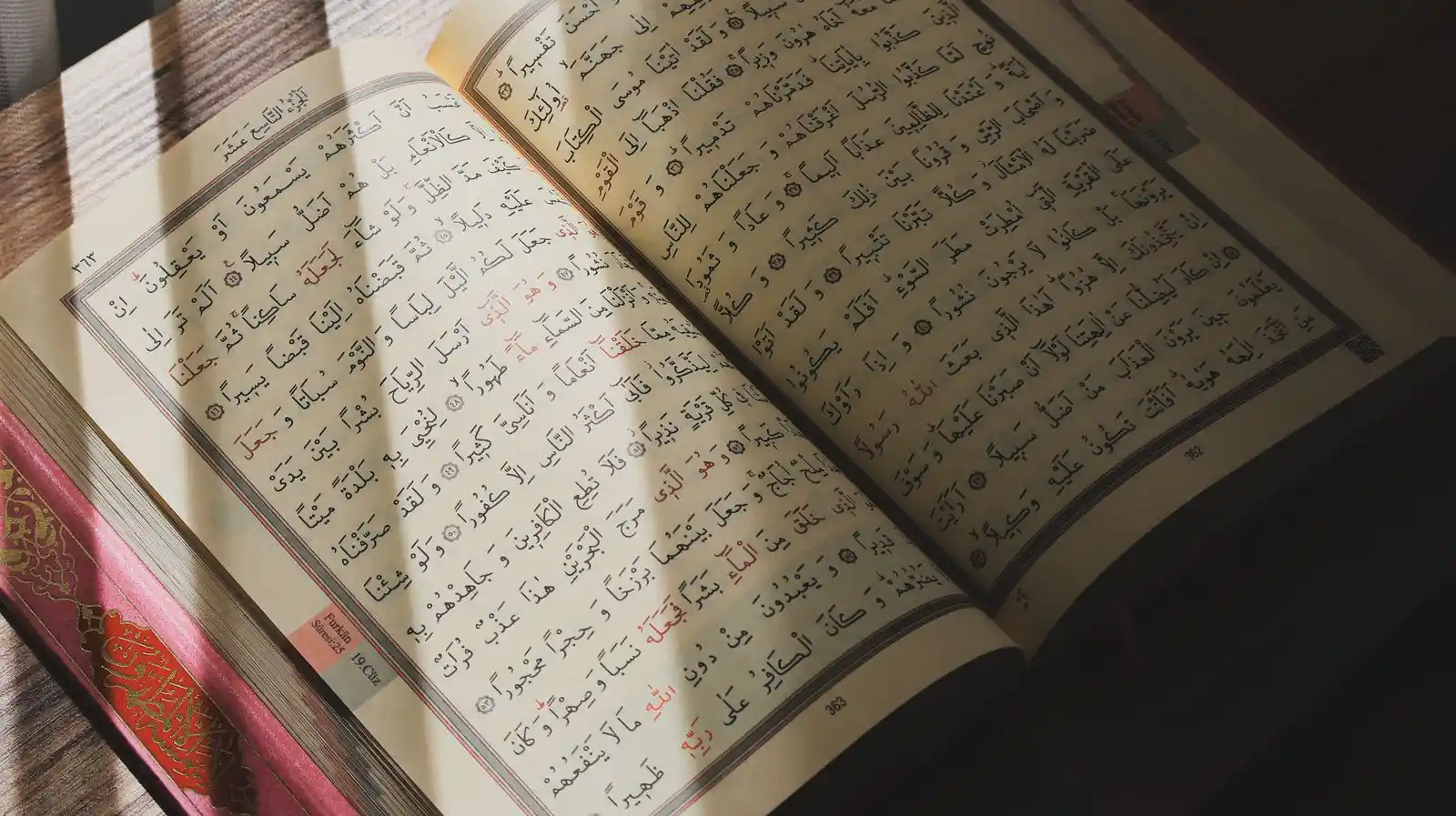
“And bring to witness two witnesses from among your men. And if there are not two men [available], then a man and two women from those whom you accept as witnesses – so that if one of the women errs, then the other can remind her.”
— From Surah Al-Baqarah, verse 282 (Sahih International — quran.com)
This clause shows the centre of the matter. The verse does not diminish the woman’s human worth; it sets up a supportive mechanism in an area that leaves no room for error — commercial records, debt, documents, and financial details.
In the same Islamic law, in a spouse’s accusation of adultery (li’an), the woman’s oath and testimony are held completely equal to the man’s; the woman can, by herself, nullify the man’s claim. Again, in areas such as childbirth, virginity, breastfeeding, and physical or medical matters specific to women — which men cannot observe — even a single woman’s testimony may be accepted as valid.
This picture tells us: in Islam, testimony is not reduced to a single mould. Whatever the subject is, the nature and expertise of that subject are taken into account.
The context layer: whose field was commerce?

To understand this ruling correctly, the historical, social, and cultural context of the era must be considered.
In the society into which the Qur’an was revealed, lending and borrowing, making contracts, and conducting general commercial dealings were largely the field of men. Women were generally not the active party in such complex financial transactions. This is not a claim of deficiency about a woman’s mind or personality; the matter is a difference of experience in a particular field at a particular time.
A person distant from commercial life may be more likely to err when recalling difficult financial details. The verse does not ignore this possibility; at the same time it does not leave the woman alone within a heavy burden of testimony. By saying “so that if one errs, the other can remind her,” it sets up a structure in which two women can support each other.
So the purpose of the ruling is not to belittle the woman, but to prevent, in commercial disputes, the loss of a right, the denial of a debt, or the weakening of a document.
The wisdom layer: not worth, a responsibility of justice
The fundamental purpose of testimony is not to grant a person status; testimony is for the protection of a right. In a matter, whoever is more expert, more experienced, and possesses more reliable knowledge — that person’s statement is accepted as stronger. In fields where women are more expert than men, the condition of “two women instead of one man” is not sought.
The wisdom behind this ruling is explained as follows:
The key sentence here is this: this is not an ontological deficiency, i.e. one related to creation; it is a functional measure related to the field of expertise in the sociology of that time.
Testimony is not one single type: an area-by-area picture

In Islamic law, testimony varies according to the nature of the subject. The sources make this clear, area by area.
Material and commercial transactions. Based on Surah Al-Baqarah verse 282: in recording a debt, two men, or if not, one man and two women. Here the ratio appears as “one man = two women”; the reason is that women took less part in commercial life at that time and that if one forgets the other reminds her. In small purchases paid in cash, or in situations such as travel, a pledge or a written document may be given priority.
Matters specific to women. In subjects such as childbirth, breastfeeding, virginity, and women’s illnesses, the sources rely on the hadith “In matters a man cannot observe, women’s testimony is valid” and on juristic principles. In these areas even a single woman’s statement may be deemed sufficient. If the matter were truly “a woman is counted as deficient,” accepting a single woman’s testimony in these areas would be incomprehensible.
Family law. In marriage, divorce, and bequest, the hadith “There is no marriage without a guardian and two just witnesses” and Surah Al-Ma’idah verse 106 (5:106) are taken as the basis. Generally two men; according to the Hanafis, one man and two women are also accepted. In a bequest made while travelling, if there is no Muslim witness, even two non-Muslim witnesses may be accepted — so the measure is not a rigid hierarchy of worth, but the protection of the right according to circumstances.
Criminal law. In adultery, theft, and grave criminal cases, definite evidence and testimony conditions are set within the frame of Surah An-Nisa verse 15 (4:15) and Surah An-Nur verse 4 (24:4) (four witnesses for adultery). The principle that fixed penalties fall away with doubt, and the heavy burden of testimony, are essential. Yet in the li’an situation, the four-times oaths of the spouses carry legally equal weight.
Religious and administrative determinations. In sighting the new moon, transmitting hadith, and conveying news, the statement of a trustworthy person is taken as the basis without regard to gender; for the Ramadan crescent, the statement of a single upright person may suffice.
General defence of rights. Surah Al-Mujadila verse 1 (58:1) and the practices show that the woman is a legally free and independent person. The woman can seek her right, object, apply, and her word finds legal response.
Spiritual and representative testimony. Within the frame of Surah Al-Baqarah verse 143 (2:143) and Surah Al-i Imran verse 18 (3:18), the Muslim community — women and men — being living witnesses of the truth on earth is in question; here equality is essential.
Today’s perspective
Today this subject is often presented as “Islam counts a woman as half of a man.” But this reading ignores both the context of Al-Baqarah 282 and the different types of testimony in Islamic law.
The emphasis is clear: this practice reflects not the woman’s worth but the division of labour and commercial experience of that day. Today women are educated and specialize in fields such as economics, commerce, law, and finance. If a woman is expert in commerce, her single testimony is also valid; this is conveyed as the view of the majority (jumhur) of scholars.
So the matter is not the question “is a woman half?” The matter is this: in which subject is who more competent, more experienced, and who can bear testimony more firmly to the protection of the right?
The four most common mistakes
The first mistake is to say “Islam counts a woman as half a human.” Testimony is not a measure of human worth but a legal responsibility; this is not an ontological deficiency.
The second mistake is to think “this rule applies in every court.” The expression concerns, in particular, the commercial-debt verse; in criminal law, family law, religious news, matters specific to women, and the seeking of rights, there are different rulings.
The third mistake is to say “a woman’s word never counts by itself anywhere.” In childbirth, breastfeeding, virginity, and matters specific to women, even a single woman’s statement may be deemed sufficient.
The fourth mistake is to say “this is simply male superiority.” The matter is expertise, reliability, sharing the burden, and the protection of the right; in some areas what is decisive is the woman’s expertise.
Summary
In Islam, the matter of two women being taken as witnesses together with one man is not an absolute measure of male–female worth spread across all areas of law. This arrangement is a measure, in the area of commercial debt and financial records, aimed at protecting the right within the conditions of that era.
The overall picture of Islamic law is broader: a supportive testimony mechanism in commercial debt; a single woman’s testimony in matters specific to women; equal weight in areas such as li’an; an independent legal personality in seeking rights; shared responsibility in spiritual testimony.
The question is not: “Why does Islam count a woman as half in testimony?”
The real question is:
“In which subject does which arrangement of testimony best protect the right and most firmly establish justice?”
DuaMio Wisdom Series
Wonder. Understand. Live.
Coming soon
Listen to these topics in the app, track your progress.
In the DuaMio app you’ll listen to every topic — not to memorize, but to comprehend.
Image note: The images in this article are license-cleared stock images chosen to suit the subject. Each image’s source and license are noted in its media description.
Content note: This article was compiled with AI assistance based on reliable sources; Quran verses are quoted verbatim from the approved translation (Sahih International for English), and the article was reviewed editorially and for religious sensitivity before publication.