
Surah An-Nisa, verse 34 is one of the most debated verses of the modern age. Some read it as “Islam commands men to beat their wives.” But when the verse is read within its Arabic linguistic structure, the context of the pre-Islamic age, the practice of the Prophet, and the family ethic of Islam, this conclusion is not correct.
Here the DuaMio Wisdom approach does this: first it clarifies the ruling, then it shows the context, then it carries the wisdom into language today’s reader can understand.
Short answer: not a command, a process that restrains violence
Islam does not command men to beat their wives. In the case of a serious marital breakdown (nushuz), An-Nisa 34 describes a three-stage process: first advising, then separating beds, and finally the step expressed by the verb “darabe.” The verb “darabe” in Arabic is multivalent; it means to strike, to part, to withdraw, to set out on a journey, to give an example, and more. The Prophet, for his part, never struck his wives throughout his life.
In the translation of Sahih International the verse reads:
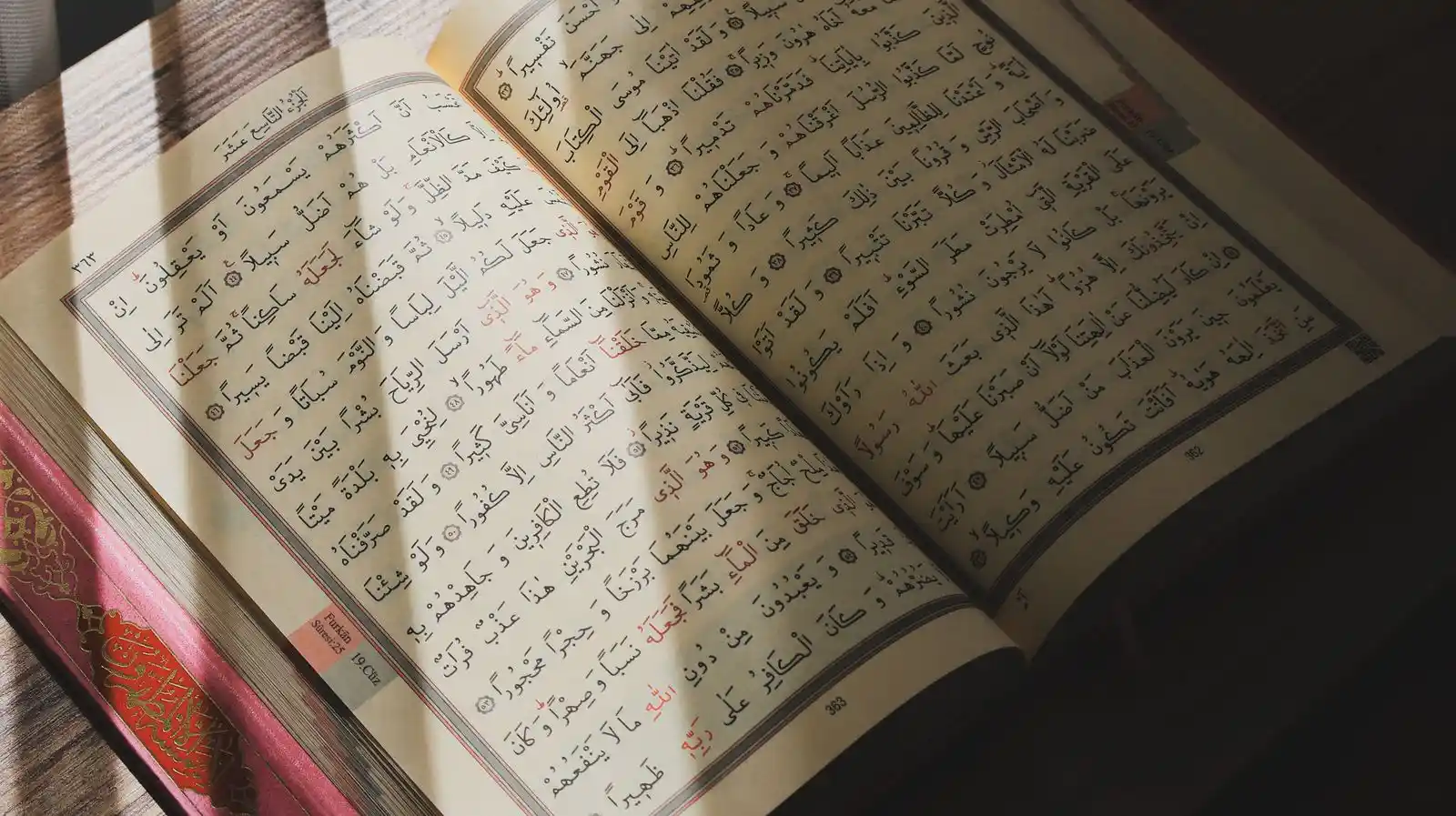
“Men are in charge of women by [right of] what Allah has given one over the other and what they spend [for maintenance] from their wealth. So righteous women are devoutly obedient, guarding in [the husband’s] absence what Allah would have them guard. But those [wives] from whom you fear arrogance – [first] advise them; [then if they persist], forsake them in bed; and [finally], strike them [lightly]. But if they obey you [once more], seek no means against them. Indeed, Allah is ever Exalted and Grand.”
— From Surah An-Nisa, verse 34 (Sahih International — quran.com)
The translation itself shows the limits of the matter: it renders the verb with the qualification “[lightly]” and only “[then if they persist]” — that is, after the earlier stages have failed. So what is at stake is not a free rein for violence in a moment of anger, but a final and limited step taken when the earlier stages bring no result.
This structure aims not at going straight to violence or divorce in a moment of anger, but at placing time, distance, and room for reflection in between. While in the society of the Age of Ignorance women were subjected to severe violence, the Qur’an brings a process that brings this culture of violence under control, limits the man’s anger, and aims to cool the family down before it collapses.
The ruling layer: violence is not Islam’s family ethic
In Islam, tormenting one’s spouse, humiliating her, wounding her, or applying physical violence out of a feeling of revenge is not legitimate. According to what is transmitted in the sources, the Prophet never struck his wife; on the contrary, he established the family ethic with this measure:
“The best of you is the one who is best to his family.”
When a complaint came in the Medinan period that some men were beating their wives, the Messenger of Allah warned his companions and, in the words transmitted in the sources, sharply rejected this act by saying, “From now on women shall not be beaten!” He also condemned those who beat their wives by day and shared the same bed with them by night.
Even if the verse is interpreted as a physical measure, classical jurisprudence stated that this could not take the form of striking the face, leaving a mark, wounding, or causing pain. Even this shows that the matter is not an unlimited permission for violence.
In modern semantic interpretations, the verb “darabe” is understood according to context as “to withdraw,” “to part,” “to leave the house,” or “to give respite.” This reading shows the aim of the verse more clearly: not to legitimize violence, but to cool the conflict.
Why is the word “darabe” debated?

The Arabic root D-R-B has a very wide field of meaning. In the Qur’an and in the language it is used not only in the sense of “to strike,” but also in senses such as to travel the earth, to give an example, to seal, to cover, and to separate.
For this reason, tearing the word in the verse from its context and translating it only as “to beat” is a deficient reading. Which meaning the word carries is evaluated together with the sentence, the subject, and the general principle of mercy in the Qur’an.
In An-Nisa 34 the matter is the danger of a family falling apart. In this context, the meaning of “withdrawal/parting” strongly shows that the verse aims not at violence but at distance and cooling.
The context layer: Islam set a limit where women were objects of violence
In the Age of Ignorance, women often had no legal or human security. Women could be beaten to death and left to the man’s unlimited power within the family.
An-Nisa 34 came down into such a world. The verse did not tell the man “do as you wish”; it broke anger into stages, first asked for counsel and communication, then placed distance by separating beds, and left the final stage within a limited and debated expression.
This is an arrangement that brought the era’s reflex of violence under control. The aim is not to crush the woman, but to cool a domestic crisis before divorce or before it explodes.
The wisdom of the three stages

1. Advising
The first step is communication. The problem is addressed by talking, engaging reason and conscience. This shows that the word comes before brute force.
2. Separating beds
The second step is emotional and physical distance. It creates a cooling space within the same home without escalating tension. It gives both parties the chance to think, calm down, and restrain anger.
3. Darabe: withdrawal or a final warning
The last step is the final act of stirring or withdrawing before the family falls apart. If read with the meaning of “withdrawal,” it carries a function similar to the restraining order in modern law: to separate the parties, prevent physical conflict, and cool the crisis. Even when read in its physical sense, striking the face, leaving a mark, or causing pain is absolutely forbidden.
What does qawwam mean in the man-woman relationship?
The verse defines men as bearers of a protective and provider responsibility in the family (qawwam). This does not give the man a right of arbitrary domination; on the contrary, it makes his responsibility heavier.
In Islam the family is built on love, mercy, and justice. Even if there is authority, it is limited by mercy, gentleness, and responsibility. The woman’s dignity is protected; violence is incompatible with the life of the Prophet.
Today’s perspective
Today this verse is often read torn from the Qur’an’s whole family ethic, from the practice of the Prophet, and from the breadth of meaning of the Arabic word. When it is read this way, the verse is presented as if it were an unlimited permission for violence.
Yet according to the sources the final aim of the verse is not violence, but bringing a domestic crisis under control. Just as a restraining order in modern law aims to separate the parties and prevent violence, the interpretation of withdrawal in the verse points to a similar psychological and sociological aim.
It must be said clearly: a man who harms his wife, humiliates her, wounds her, or beats her has trampled on the Qur’an’s aim of mercy and the family ethic of the Prophet.
Common misunderstandings
1. “The verse gives men unlimited permission to beat.”
No. The verse describes a three-stage crisis management; moreover, even the translation gives the verb with the qualifications “[lightly]” and “[then if they persist].” Violence is not an unlimited right.
2. “The word darabe only means to beat.”
No. The root D-R-B is multivalent; it also carries meanings such as to withdraw, to separate, and to give an example.
3. “The Prophet applied this verse as violence.”
No. According to what is transmitted in the sources, the Prophet never struck his wife.
Summary
An-Nisa 34 is not a text that encourages violence against women. When a family comes to the threshold of collapse, it offers a process to control anger and cool the crisis in stages.
When the multivalence of the word, the context of the Age of Ignorance, and the example of the Prophet are read together, the message of the verse is clear: mercy, not violence; responsibility, not domination; cooling, not explosion.
The question is not: “Why did Islam command men to beat women?”
The real question is:
“When a domestic crisis erupts, how is it managed with mercy, without anger turning into violence and without anyone’s dignity being trampled?”
DuaMio Wisdom Series
Wonder. Understand. Live.
Coming soon
Listen to these topics in the app, track your progress.
In the DuaMio app you’ll listen to every topic — not to memorize, but to comprehend.
Image note: The images in this article are license-cleared stock images chosen to suit the subject. Each image’s source and license are noted in its media description.
Content note: This article was compiled with AI assistance based on reliable sources; Quran verses are quoted verbatim from the approved translation (Sahih International for English), and the article was reviewed editorially and for religious sensitivity before publication.