Discovery Blog > Animals > Birds
Short Answer
A gull’s wing does not remain in one fixed form like an airplane wing. Through the shoulder, elbow, and wrist joints, wingspan, sweep angle, and surface shape can change. This change helps the bird shift between stability and agility in flight.
This mechanism is one of the principles that inspires morphing-wing drone designs. Up close, a gull’s wing is not only “feathers that enable flight”; it is a movable, adjustable, and highly sensitive aerodynamic surface.
What Are We Observing?
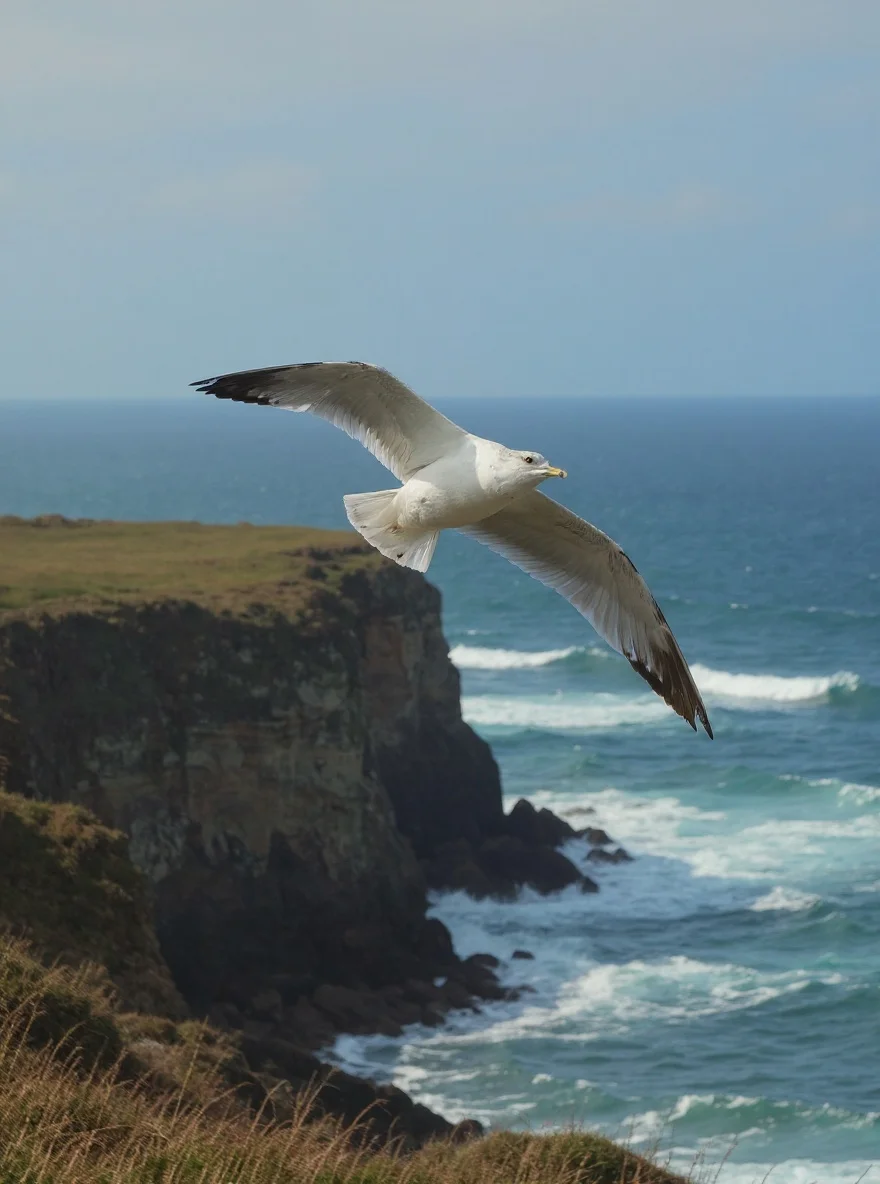
When you watch a gull on a windy coast, you may see it sometimes gliding with almost no wingbeats, and sometimes changing direction with a sudden turn. The same bird, with the same wings, can show both stable gliding and agile maneuvering. One of the things that makes this possible is the wing’s ability to change shape through its joints.
A gull’s wing is not a single-piece plate. It begins at the shoulder, takes different angles through the elbow and wrist regions, and the position of the feathers also affects airflow. For this reason, the wing adapts to different flight situations by changing its angle and planform relative to the body.
The Science
A study published in PNAS, with an open-access PMC version, shows that gulls can control dynamic pitch stability through wing morphing. When the bird brings its wing into different joint positions, the aerodynamic center of the wing and its relationship to the body change. This can make flight either more stable or more open to maneuvering.
A morphing-wing drone study published in Nature Communications also shows that robotic systems inspired by changes in bird wing shape can provide advantages in agile landing and perching maneuvers. In particular, elbow/wrist-like shape changes affect how the aircraft dissipates energy and changes direction.
The safe scientific expression here is this: gulls can shift between stability and agility by shaping their wings through their joints. Absolute statements such as “every gull makes extremely sharp turns in every situation” should not be used.
The “Wow” Moment
The “wow” point is that the gull’s wing can answer two opposite needs at the same time. Stability is important in flight, because an unstable body can easily lose balance in the air. But maneuverability is also important, because the bird must respond quickly to wind, prey, landing, and changes in direction.
In human-made vehicles, these two features can sometimes conflict. A very stable aircraft may be less agile; a very agile vehicle may require more sensitive control. In the gull’s wing, however, shape change makes it possible to move between these two ends. The wing does not remain in one “setting”; different aerodynamic characters emerge according to the flight situation.
Inspired by Nature
This mechanism is directly important for highly maneuverable drones and morphing-wing UAV systems. In traditional drones or small fixed-wing aircraft, the wing often has a certain form. In systems inspired by birds, however, wingspan, sweep angle, or surface shape can be changed.
For engineers, the problem is this: an aircraft should both glide efficiently and move agilely in a narrow area. Bird wings offer biological examples that combine these two in the same structure. Studies inspired by gulls show that wing morphing is not only an aesthetic idea, but a real engineering principle that affects flight control.
Up Close
Think of a paper airplane. When you bend its wings slightly upward, its flight changes. If you bend the back part just a little, its direction can change. Now imagine this as a living, jointed wing covered with feathers and capable of responding instantly to airflow. What happens in a gull’s wing is far more complex and sensitive than that.
When wing shape changes, air flows differently over and under the wing. This affects lift, drag, and tendencies to rotate. Even a small change in angle can change the flight character.
A Window for Reflection
This observation makes us think about measure and flexibility in creation. The wing given to the gull is not a fixed structure that merely keeps it in the air; it is a system that can show different functions according to changing wind and movement. The wonder here is not to attribute independent skill to the bird, but to reflect on the knowledge of the Creator who gave it such a body and such ability to move.
A person often looks at a bird gliding in the sky and simply says, “it is flying.” But up close, inside that flight there is geometry, fluid mechanics, balance, and fine adjustment. Reflection begins exactly here: noticing the measure behind a familiar sight.
What It Tells Us Today
The gull’s wing teaches us that adaptation is sometimes not in rigidity, but in flexibility. Being able to change form according to changing conditions provides a great advantage both in nature and in engineering. But this flexibility is not random; it works within certain limits, joints, and measures.
Scientifically, this subject teaches aerodynamics. In terms of life, it reminds us of this idea: sometimes being strong does not mean staying in one form, but taking the right shape at the right time.
DuaMio Discovery invites us to read even an ordinary gull flight in the sky carefully. The order hidden in a small change of wing angle reminds us of both science and calm wonder over creation.
Discover, marvel, remember the Creator.
Sources
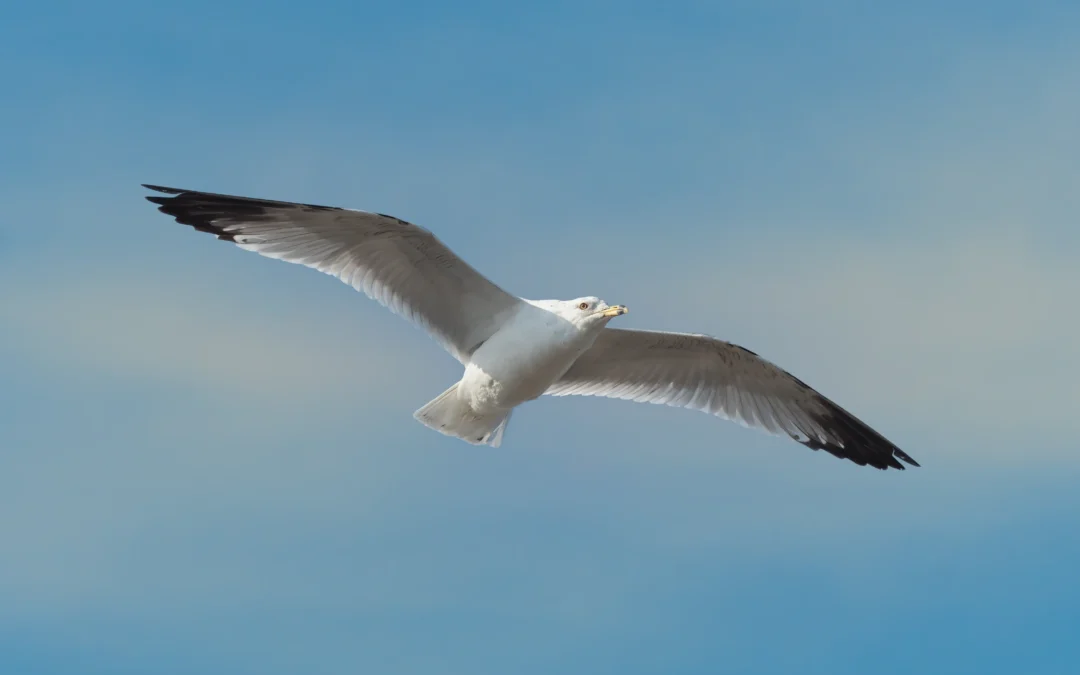
- Hero image source: File:Ring-billed gull in flight (94615).jpg
- https://pmc.ncbi.nlm.nih.gov/articles/PMC9477410/ — Wing morphing and dynamic pitch stability in gulls.
- https://www.nature.com/articles/s41467-024-52369-4 — Bird-inspired morphing-wing drone maneuvers.
- https://pmc.ncbi.nlm.nih.gov/articles/PMC11430708/ — Secondary support for the gull-inspired CGull morphing drone study.
Image note: The hero image of this article is a real source photograph; kaynağı burada. The three in-article images were generated with AI from that real reference to illustrate the subject more clearly.