

Discovery · Animals · Birds
Short Answer
The disk-shaped feather arrangement on an owl’s face works like a natural acoustic structure that directs sound toward the ears. Especially in barn owl studies, the facial feathers called the facial ruff have been shown to strengthen sound localization. This structure helps collect sound waves and make directional information clearer.
This mechanism reminds us of satellite dishes and hearing aids. In all of them, the basic question is similar: how can a weak or scattered signal be collected better and made meaningful?
Real observation video (BBC Earth): how the owl’s extraordinary hearing works.
What Are We Observing?
When you look at an owl from the front, you notice that its face is not flat, but arranged inward like a disk. This facial disk is not only a cute appearance. The position of the feathers and their relationship to the ear openings play an important role in determining the direction of sound.
Owls, especially nocturnal hunting species, depend heavily on hearing. Hearing the faint rustle made by a small living being in the dark and locating it provides a vital advantage in environments where visual cues are limited.
The Science

A barn owl study listed on PubMed shows that facial ruff feathers direct sound toward the ear openings and that ear directionality is stronger when the ruff is intact. This structure affects cues such as interaural time difference and interaural level difference. In other words, when and with what intensity sound reaches the two ears helps the brain calculate direction.
The PLOS One study tests the effect of the facial disk at the behavioral level through a virtual ruff removal method. When the ruff effect is removed, the owl is seen to struggle especially with elevation and front-back discrimination. The study also notes that this information could inspire fields such as auditory displays, autonomous agents, and hearing aids.
The “Wow” Moment
The “wow” point is this: the owl’s face is, in a sense, a face “shaped for hearing.” We think of the ear only as an organ on the side of the head. But in the owl, even facial feathers become part of the hearing system.
A satellite dish is bowl-shaped to collect signals. In the owl’s facial disk, we see a similar principle: collecting waves, directing them, and making them more understandable. Of course, one is biological and the other an engineering product; but the similarity at the principle level is very instructive.
Inspired by Nature
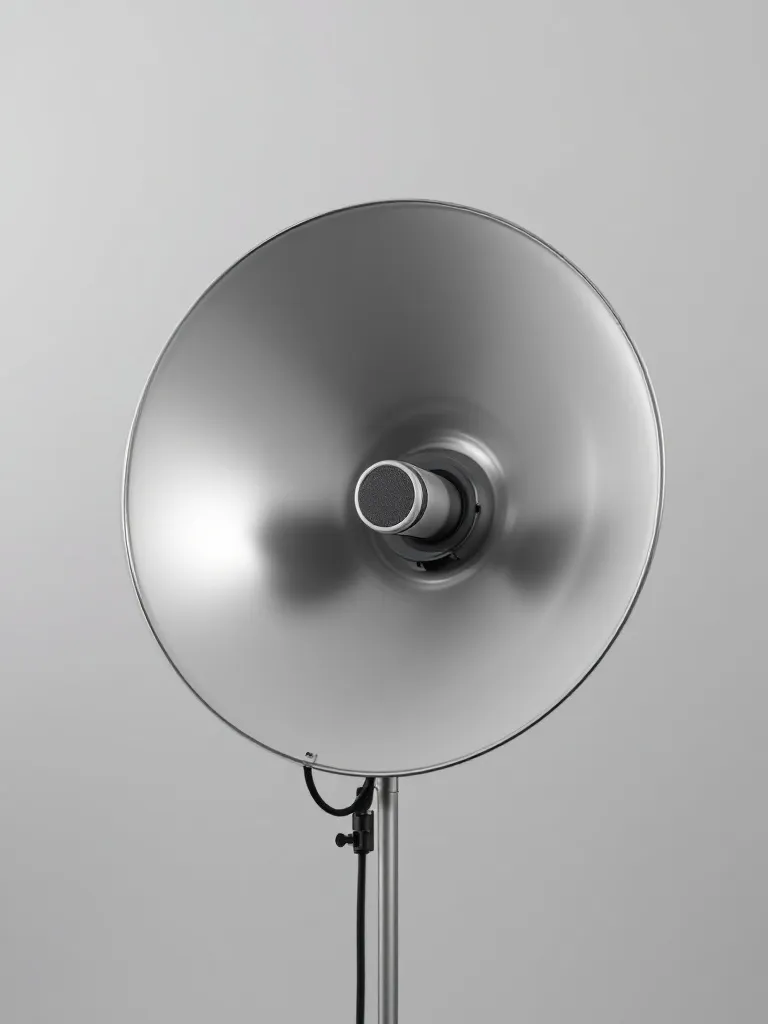
This subject creates a strong connection with satellite dishes and hearing aids. A satellite dish tries to collect electromagnetic waves, while a hearing aid tries to collect and process sound signals better. The owl’s facial disk also helps sound waves reach the ears with more meaningful directional information.
As the PLOS One study points out, barn owl facial ruff data offer a model worth considering for virtual auditory environments, autonomous agents, and hearing aids. There is no need to say that “the hearing aid was invented from the owl”; the owl’s sound localization principles are inspiring for engineering.
Up Close
If you put your hands behind your ears and cup them slightly forward, you hear some sounds more clearly. That is because the shape around the ear affects the arrival of sound. In the owl, this principle appears through a much more specialized feather architecture.
The facial disk does not only increase sound; it also creates clues about where the sound comes from. Understanding whether a tiny rustle comes from above or below, from the front or the back, is important for hunting.
A Window for Reflection

When we look carefully at an owl’s face, we notice that there is function behind appearance. The facial disk is not only shape; it carries a measure related to sound. This wonder is not for giving independent mastery to the owl itself, but for reflecting on Allah’s creation, who gave it this structure.
Such a system that helps find direction in darkness also reminds a person of the blessing of hearing. We often take sounds as ordinary; yet hearing, distinguishing direction, and making meaning are deep blessings in themselves.
What It Tells Us Today
This subject tells us that sometimes the solution is not in being stronger, but in focusing better. A structure that can collect scattered sounds can make a weak signal meaningful.
Scientifically, the owl’s facial disk teaches acoustics and signal direction. From the perspective of reflection, it helps us notice the function behind the visible shape.
DuaMio Discovery invites us to read carefully even the silent geometry on an owl’s face. This subtle order that finds the direction of sound reminds us of the measure in creation with calm wonder.
Discover, marvel, remember the Creator.
Sources
- Hero image source: File:Flickr – Rainbirder – Barn Owl (Tyto alba).jpg
- https://pubmed.ncbi.nlm.nih.gov/16721575/ — Barn owl facial ruff and sound reception properties.
- https://journals.plos.org/plosone/article?id=10.1371/journal.pone.0007721 — Virtual ruff removal and sound localization.
- https://www.barnowltrust.org.uk/barn-owl-facts/barn-owl-adaptations/ — Barn owl facial disk and hearing adaptations.
Coming soon
Listen to these topics in the app, track your progress.
In the DuaMio app you’ll listen to every topic — not to memorize, but to comprehend.
Image note: The hero is a real source photograph (see Sources). The two barn owl images in the article were AI-generated from that same real reference. The parabolic microphone image is a separate technology illustration, showing the same acoustic principle as the owl’s facial disc.
Content note: This article was compiled with AI assistance based on reliable scientific sources and editorially reviewed before publication.