Discovery > Animals > Birds
Short Answer
The lyrebird is an extraordinary example of vocal learning, able to imitate especially the calls of other bird species and natural sound patterns in its surroundings with very high accuracy. The scientific literature offers strong evidence for complex mimicry sequences, social learning, and acoustic similarity in these birds. Examples of human-made sounds such as saws, cameras, and car alarms appear in popular accounts, but in scientific writing they should be described carefully and in a limited way.
This subject shows us that sound is not only a vibration that is produced, but a complex information system that is learned, organized, and used according to context.
Real observation video: you can watch the lyrebird’s display and vocal mimicry in motion.
What Are We Observing?
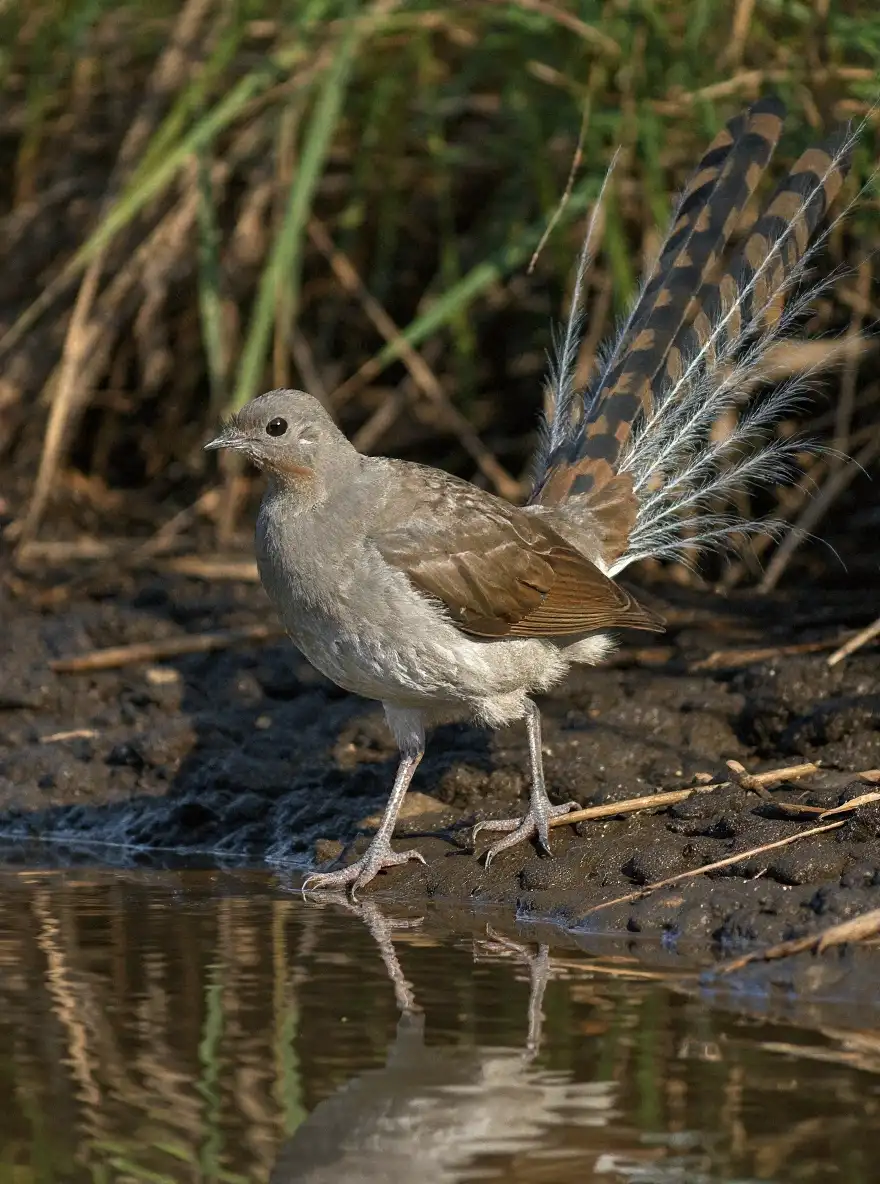
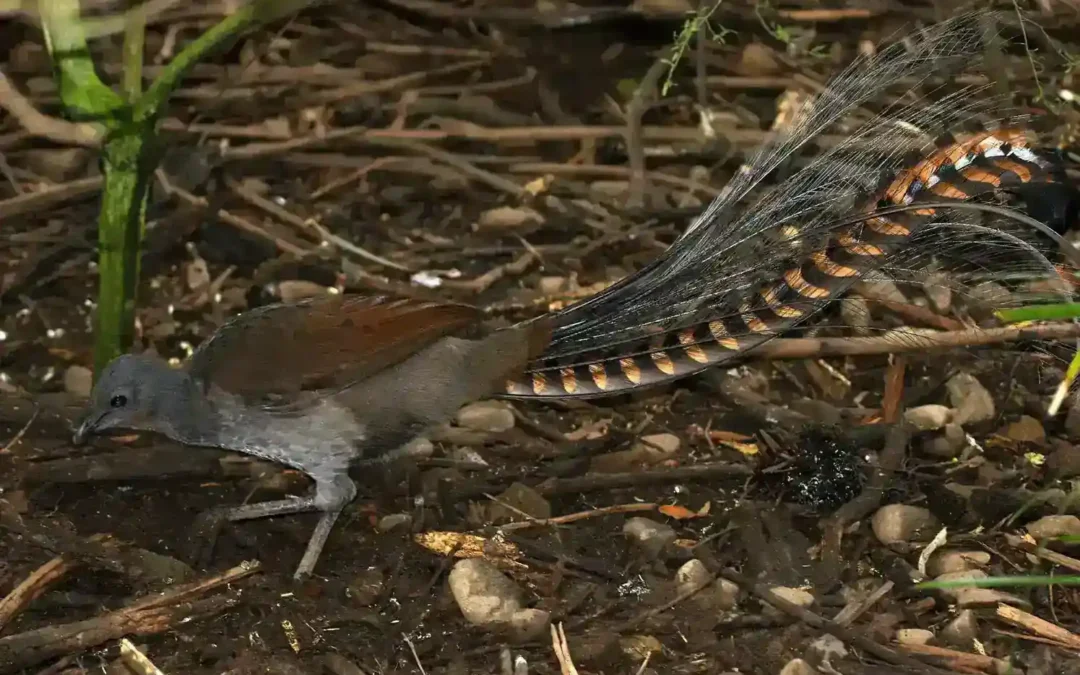
Lyrebirds, living in the forests of Australia, are among the bird world’s most famous mimics. Especially male individuals can use the sounds of different species in long and complex sequences during mating displays. Some recordings show that lyrebirds imitate other birds in the forest, alarm calls, and various environmental sounds in a surprising way.
The scientific evidence does not show that lyrebirds reproduce every sound they hear without exception. Rather, it shows that they can imitate some natural sound patterns and bird calls in their environment with remarkably high accuracy. That is what makes them one of the strongest examples of vocal learning in birds.
The Science
Mimicry behavior in lyrebirds is not only copying a single sound. Research shows that in some male Albert’s lyrebird individuals, vocal mimicry sequences are socially transmitted and that these sequences increase acoustic contrast. This suggests that the sound repertoire may have a social dimension as well as an individual one.
The “Fooling the experts” study on the superb lyrebird shows that imitations can be so similar that even model bird species may find them difficult to distinguish. In other words, the issue is not only producing sound; it is approaching the model sound in terms of timing, frequency, rhythm, and acoustic structure.
Famous examples involving human-made sounds should be handled more carefully. The expert evaluation in The Conversation explains that in wild lyrebirds, sounds such as saws or cameras are not strongly documented in the literature, and that many well-known recordings may be linked to captivity or unusual circumstances. Scientifically, the firmer conclusion is that lyrebirds imitate natural sounds and the calls of other birds with striking accuracy.
The “Wow” Moment
The “wow” point is this: a bird’s voice is not just one “song.” The vocal system and learning ability given to the lyrebird work with enough complexity to combine the calls of different species into a display sequence. It is almost like an acoustic collage forming in the forest.
The human ear sometimes hears only “a bird is singing.” Yet in careful analysis, it can be seen that one call resembles another species’ alarm, one melody resembles another bird’s song, and one sequence resembles a structure transmitted through social learning.
Inspired by Nature
This subject creates a strong principle-level connection with sound recording and analysis technologies. The lyrebird is not directly a sound recording device; but in terms of perceiving, storing, reproducing, and analyzing sound patterns, it opens a powerful field of thought for humans.
Modern sound analysis uses waveforms, frequency distributions, spectrograms, and pattern recognition systems. To understand whether a sound is truly similar, the ear alone is not trusted; acoustic features are compared. Lyrebird studies therefore show that sound is a scientifically measurable structure.
Up Close
You can recognize a friend’s voice immediately on the phone. That is because sound is not made only of words; tone, emphasis, rhythm, and frequency structure are also present. In lyrebird imitations too, what matters is not only a sound that “seems the same,” but detailed acoustic similarity.
In a spectrogram, sound lines become visual. When the sound imitated by the lyrebird and the model sound are placed side by side, similarities and differences can be examined more clearly. This reminds us that sound is an invisible but measurable world.
A Window for Reflection
The lyrebird example is a beautiful window for thinking about blessings such as hearing, learning, and sound production. We realize that the sounds echoing in a forest are not merely noise; they carry an order woven with abilities given to living beings.
Wonder here is not directed toward elevating the bird as “an artist producing miracles on its own.” One reflects on the creation of Allah, who gave it these sound organs, learning capacity, and behavior patterns suited to its environment. Even in something invisible like sound, there is measure, memory, and order.
What It Tells Us Today
This subject teaches us to listen. Most of the time we consider the sounds around us background noise. Yet when we listen carefully, we notice that every sound has a source, a structure, and a context.
Scientifically, the lyrebird tells us about vocal learning and acoustic analysis. From the perspective of reflection, it helps a person look more carefully at the blessing of their own hearing and the order of sounds around them.
DuaMio Discovery aims to make us notice again the things we hear but often do not think about. The lyrebird’s imitations remind us how much subtle order can lie behind the sounds that reach our ears.
Discover, marvel, remember the Creator.
Sources
- Hero image source: File:CSIRO ScienceImage 10357 Superb Lyrebird Mt Buffalo Victoria.jpg
- https://pmc.ncbi.nlm.nih.gov/articles/PMC8905160/ — Socially transmitted vocal mimicry sequences in Albert’s lyrebird individuals.
- https://www.sciencedirect.com/science/article/abs/pii/S0003347212001248 — Acoustic accuracy of superb lyrebird imitations.
- https://openresearch-repository.anu.edu.au/items/92c36dd5-90b7-4b76-b30b-643c8e51f45f — Ecology of superb lyrebird vocal mimicry.
- https://theconversation.com/lyrebirds-mimicking-chainsaws-fact-or-lie-22529 — Careful evaluation of claims about human-made sounds.
Coming soon
Listen to these topics in the app, track your progress.
In the DuaMio app you’ll listen to every topic — not to memorize, but to comprehend.
Image note: The hero image of this article is a real source photograph; source here. The three in-article images were generated with AI from that real reference to illustrate the subject more clearly.
Content note: This article was compiled with AI assistance based on reliable scientific sources and editorially reviewed before publication.