Short Answer
Watch a frog catch and swallow an insect in slow motion and you will see its eyes briefly sink inward into its skull. This odd movement actually helps the frog swallow. In most frogs, the eyeballs can descend nearly to the roof of the mouth; the lowering eyes press down on the prey and push the bolus toward the esophagus. A thin but tough membrane between the eye and the mouth cavity keeps the eye from being swallowed — it acts purely as a piston pressing down.
One thing to clarify upfront: this is not the only way frogs swallow. The main work is done by the tongue and the hyoid cartilage system at the floor of the mouth; eye retraction is an accessory mechanism that supports them. What remains remarkable is that an organ built for seeing has been positioned to simultaneously assist with swallowing — a single structure elegantly assigned two jobs at once, without any compromise to either.
Real observation video: you can watch in close-up how a frog uses its eyes while swallowing food.
What We Observe
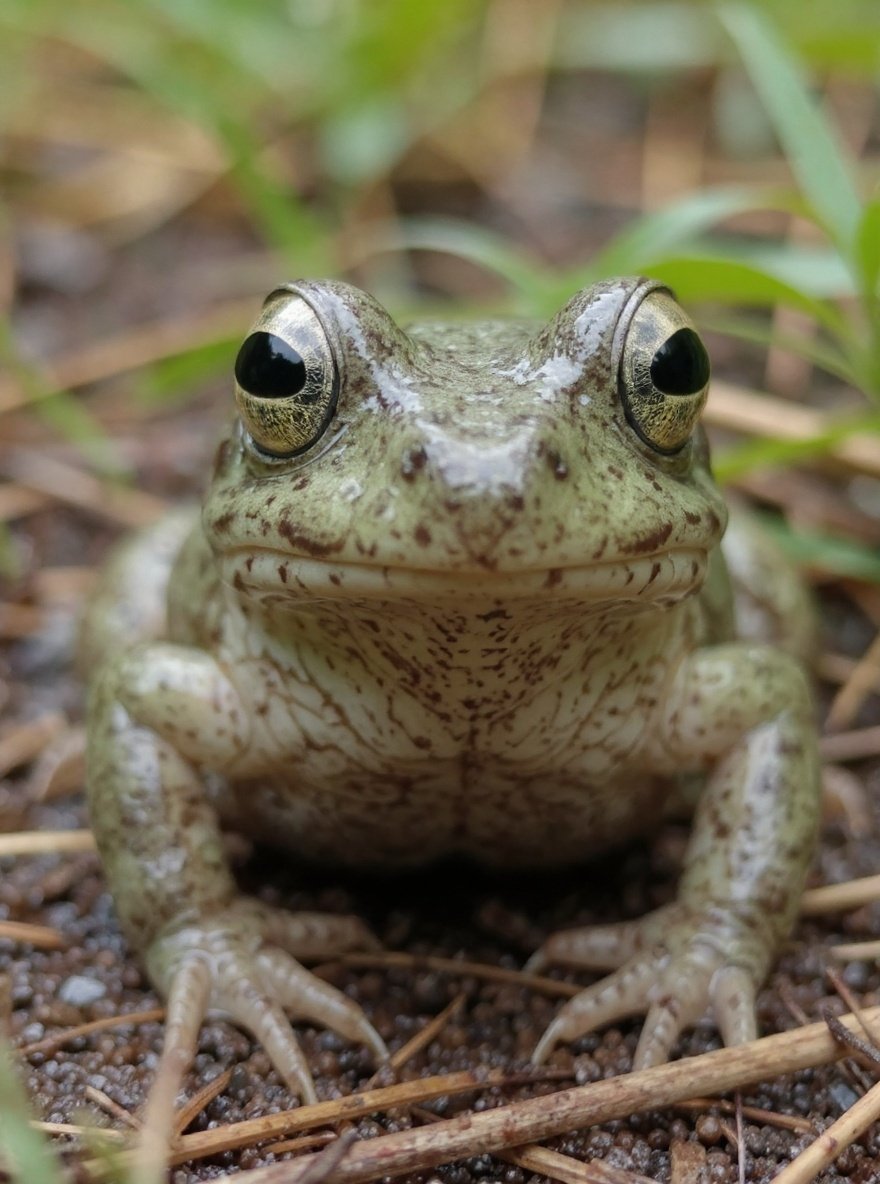
Watching a frog feed in slow motion is remarkable. The tongue flicks out, captures prey, and snaps back. Moments later the frog appears to “blink” several times — but these are not ordinary blinks. The eyes do not close outward; they collapse inward. Sometimes both eyes descend together, sometimes only one. The movement is especially pronounced when the prey is large or actively struggling.
In humans, the eyes are fixed in their sockets and cannot move inward. In frogs, muscles beneath the eyeball can actively pull it downward. The eye here is not only a sensor — it is a structural participant in the act of swallowing. A single part prepared for more than one function.
The Scientific Mechanism
The primary muscle responsible for this movement is called the retractor bulbi. When it contracts, it pulls the eyeball downward toward the roof of the mouth. Robert Levine, Jenna Monroy, and Elizabeth Brainerd published the first direct experimental test of this long-suspected idea in 2004 in the Journal of Experimental Biology. They studied northern leopard frogs (Rana pipiens) using behavioral observation, fluoroscopy (moving X-ray), electromyography (EMG), and nerve-severing experiments.
The results are clear. Fluoroscopy showed the descending eyes reaching the back of the pharyngeal cavity and making contact with the bolus. EMG recordings confirmed that the retractor bulbi muscle contracts during eye retraction. The most telling experiment was the nerve-severing trial: frogs with the muscle disabled could still swallow, but required significantly more swallowing movements to move the same piece of food. Eye retraction is therefore a facilitator — not a prerequisite — for swallowing.
Friedrich Witzmann and colleagues published a 2019 study in Integrative Organismal Biology using three-dimensional X-ray (XROMM) to examine what the eyes actually do. An older hypothesis had suggested the eyes acted as a “palatal pump” for breathing; this study refuted it. Instead, inward eye retraction primarily presses prey against the floor of the mouth, stabilizing the bolus and contributing to its rearward transport.
Rachel Keeffe and colleagues completed the picture in a 2022 paper, also in Integrative Organismal Biology, studying the cane toad (Rhinella marina) with X-ray video. Surprisingly, the tongue was found to retract further back into the skull than it extends outward. The hyoid cartilage at the floor of the mouth presses the tongue against the palate and strips the prey toward the esophagus. Eye retraction is one instrument in this larger “swallowing orchestra” — a supporting voice, not the soloist.
The Wow Factor
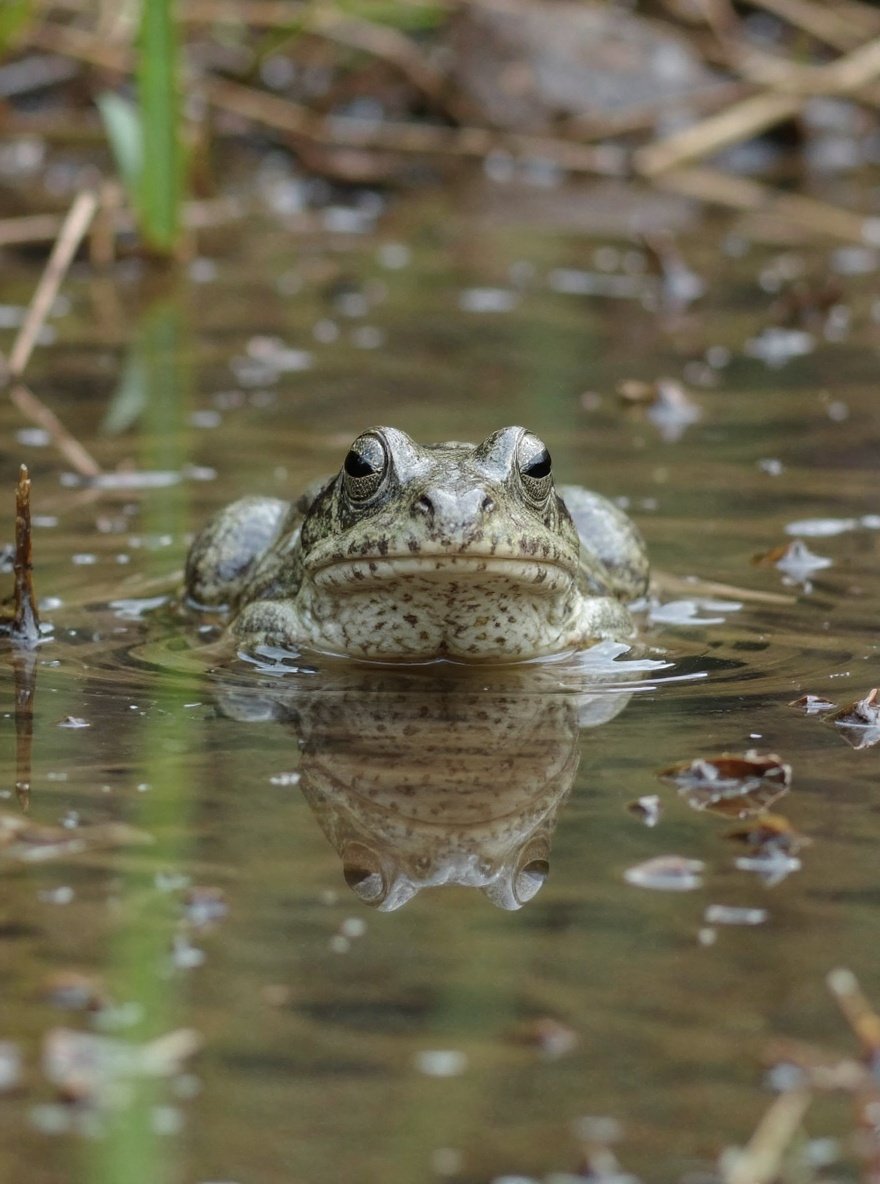
The truly surprising thing here is not that the eye “helps with swallowing.” The remarkable part is this: an organ built for vision has been assigned a second job without losing anything from the first.
Consider: when an engineer wants a single component to perform two functions, there is usually a compromise — the part does one job well and the other adequately. Here, the eye remains a fully functional visual organ while also being equipped to act as a piston during swallowing. And between the eye and the mouth, a thin protective membrane was placed — so the secondary function comes with its own safety feature built in.
An organ built for seeing also works precisely enough to assist with swallowing.
Inspired by Nature
To be honest: unlike the tree frog’s adhesive toe pads, there is no well-documented case of frog eye retraction being directly copied into a human-made device. So the inspiration here is not a product — it is a principle.
And that principle is highly valued in engineering: assigning multiple functions to a single component (multifunctionality), and adding a secondary support system to assist a primary one (redundancy). Aircraft, robots, and medical devices are routinely designed with backup systems that engage when the primary mechanism is strained or fails — and components are frequently given additional roles to save weight and space. The frog’s swallowing system demonstrates both principles simultaneously: tongue and hyoid do the primary work, eye retraction assists during difficult swallows, and the whole assembly uses an existing structure rather than adding a new organ.
This animal does not hand us a new tool. It reminds us how good design thinks: fewer parts doing more work, intelligent redundancy, and built-in safety for every secondary role.
Up Close
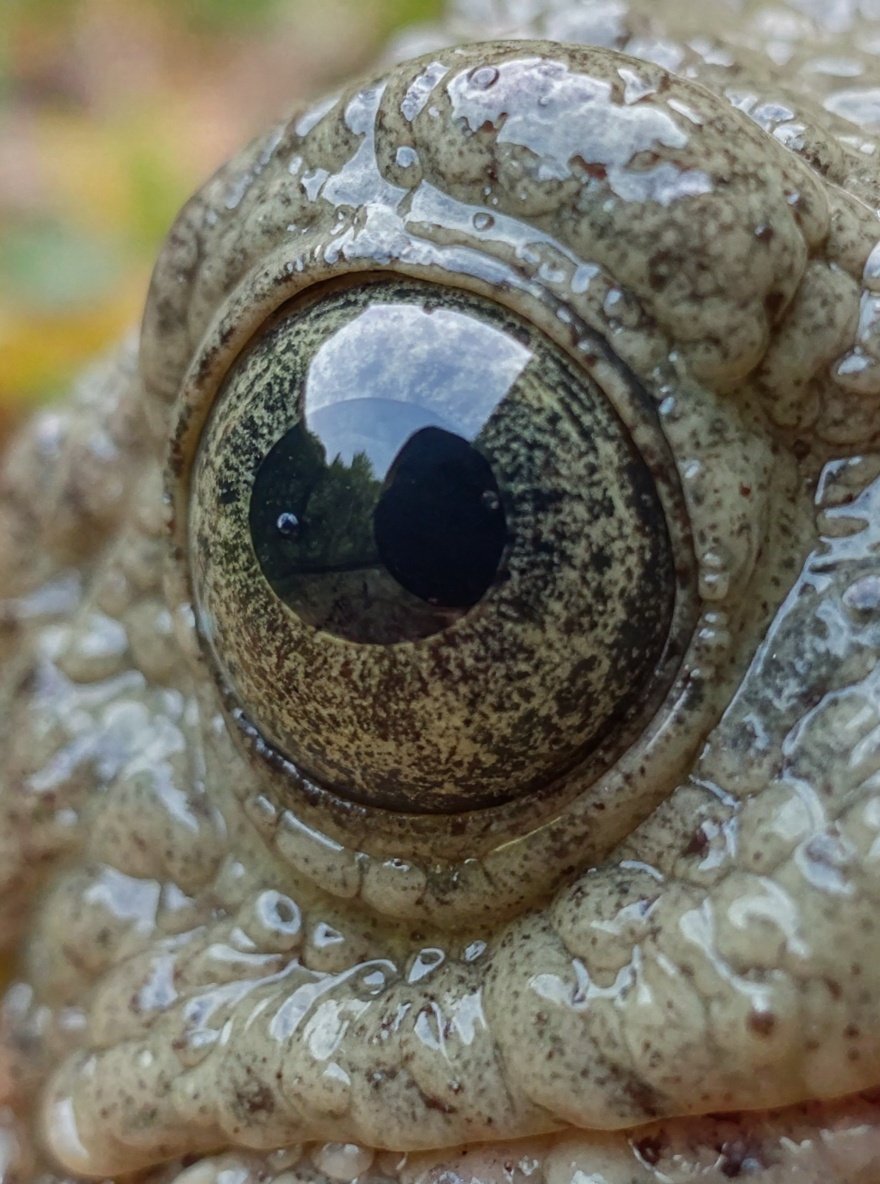
A biologist watching a frog swallow under X-ray sees a choreography invisible to the naked eye. The tongue fires and retracts; the mouth floor rises; the hyoid cartilage tenses and releases like a puppet string; and at precisely the right moment the eyeballs silently descend, touch the bolus, then return to position. All of this unfolds in a fraction of a second.
In this small scene, every part’s timing is exactly right. The eyes engage after the tongue has done its work — descend too early and the prey is missed, too late and the action is wasted. That such precise sequencing occurs at this speed, consistently, does not feel accidental.
A Window for Reflection
A frog is a humble creature. It did not design its own eye, did not assign itself the task of using it to swallow, and did not devise the thin protective membrane that keeps the eye safe during that second function. All of this was given to it — placed in its body beforehand. What we marvel at is not the frog’s cleverness; it is the design with which the frog has been endowed.
The Quran repeatedly invites us to observe the fine measure and balance (mīzān) in what surrounds us. What we see here is exactly that: a single organ assigned two non-conflicting roles, each one accompanied by a safeguard. Perfection is not in the creature — it is in the measured design given to it, and the design belongs to its Creator.
Reflection is not saying “what a clever animal.” It is pausing to ask, quietly: “Who placed this precise measure inside something this small?” When we watch a frog lower its eyes to swallow, we are looking at a wisdom embedded in a humble creature — a silent door that turns the gaze from the work to its Maker.
What It Tells Us Today
We often assume that powerful solutions require new and larger tools. The frog reminds us otherwise: sometimes the most elegant solution is giving a second function to something that already exists. No new organ was created here — the existing eye was simply leveraged to assist with swallowing.
That perspective applies equally to an engineer and to a reflective person: rather than undervaluing what we have, we can find new meaning and function in it. And seeing this fine order inside such a tiny creature turns our attention not to our own greatness, but to the wisdom of the One who arranged it.
Discover with wonder, remember the Creator.
Sources
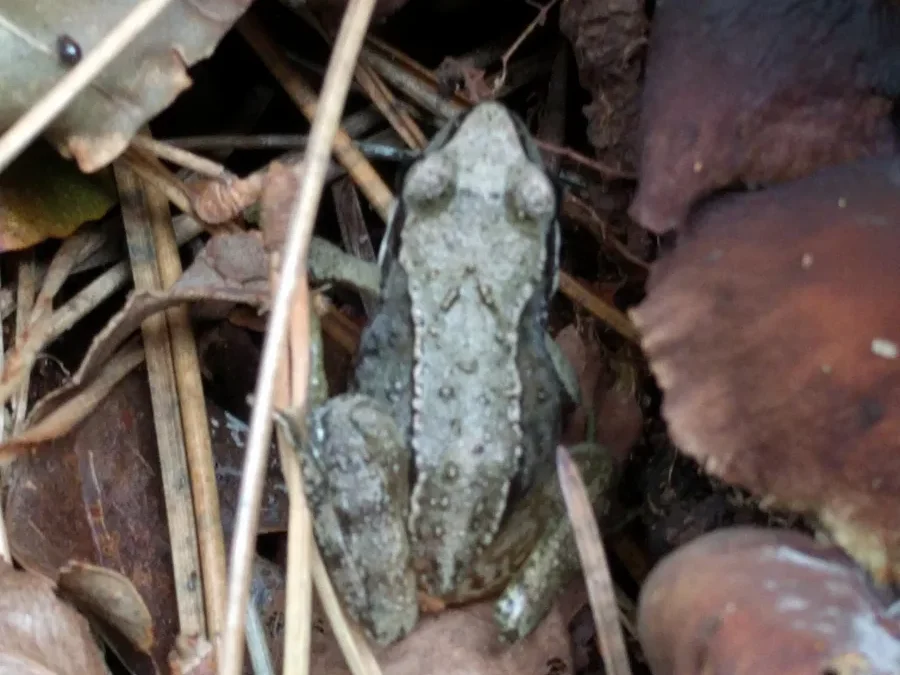
- https://commons.wikimedia.org/wiki/File:20180930_Leeuwenhorstbos_-_Bruine_kikker_(Rana_temporaria).jpg — Real source photograph used for the hero image (Wikimedia Commons).
- Levine, Monroy & Brainerd, Journal of Experimental Biology, 2004. PubMed
- Witzmann, Brainerd & Konow, Integrative Organismal Biology, 2019. Oxford Academic
- Keeffe et al., Integrative Organismal Biology, 2022. Oxford Academic
- Florida Museum of Natural History, 2022. floridamuseum.ufl.edu
- Museum of Science, Boston. mos.org
- Discover Magazine. discovermagazine.com
Coming soon
Listen to these topics in the app, track your progress.
In the DuaMio app you’ll listen to every topic — not to memorize, but to comprehend.
Image note: The hero image of this article is a real source photograph. The three in-article images were generated with AI from that real reference to illustrate the subject more clearly.
Content note: This article was compiled with AI assistance based on reliable scientific sources and editorially reviewed before publication.