Short Answer
A tree frog can cling to wet glass or a rain-slicked leaf with ease, because in the small pads at the tips of its toes, water behaves not as an enemy but almost like a glue. These pads are made of hexagonally arranged epithelial cells about 10 micrometers across, separated by narrow channels roughly 1 micrometer wide. Glands open into these channels and continuously secrete a thin mucus; the mucus forms an extremely thin liquid film between the pad and the surface, producing what is called "wet adhesion." Here is the key trick: the channels drain excess water to the sides, so the pad makes genuine close contact with the surface and never turns slippery — in the words of scientists, "wet but not slippery."
Humans spent years engineering a tire that grips on wet roads. Yet the tree frog has neither a laboratory nor a mind to design such a thing; within it, the same problem has been solved flawlessly for millions of years, in an area no bigger than a fingertip. A device this refined at such a tiny scale quietly invites anyone who looks closely to pause and reflect on the Creator.
Real observation video: you can watch the tree frog’s real body and climbing-life context in motion.
What Do We Observe?
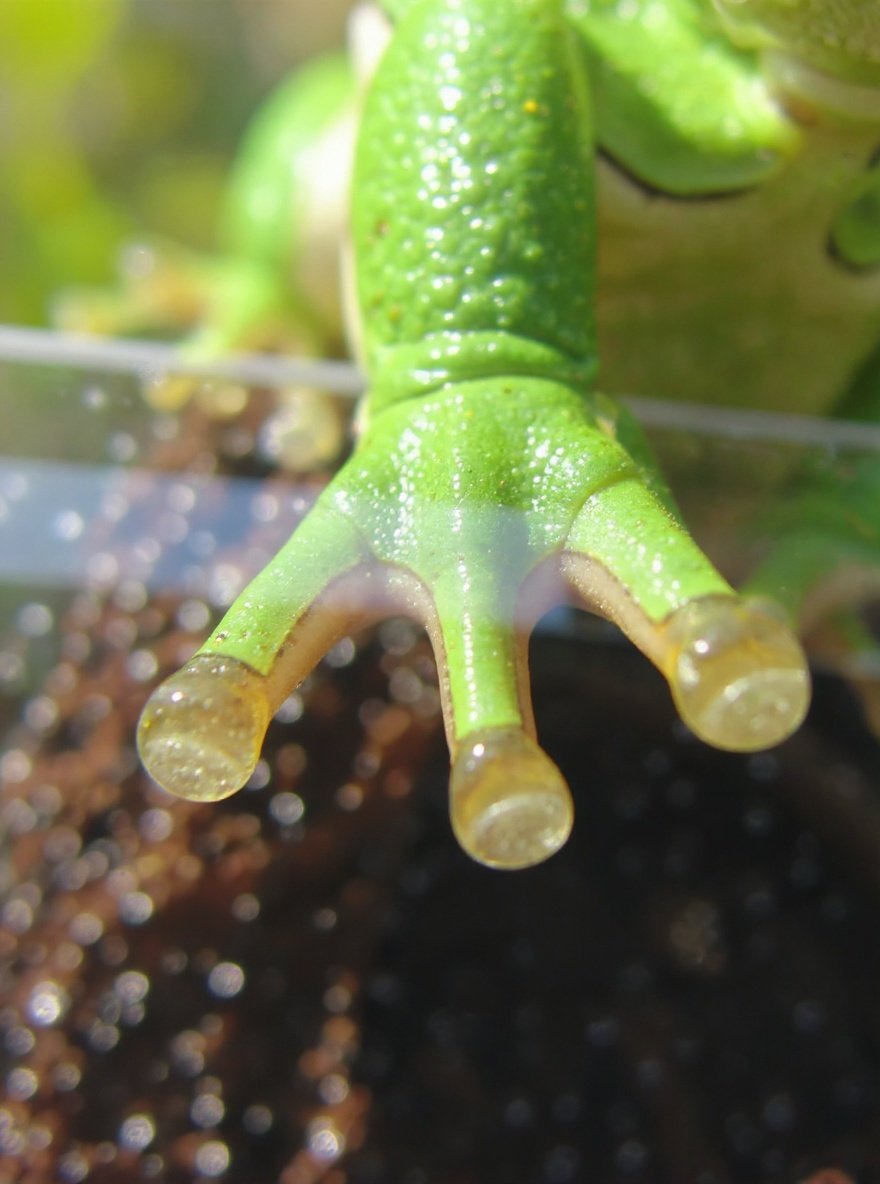
A tree frog can climb a surface as smooth as glass and covered in droplets of water — it can even hang upside down. In the same situation our shoes slide and our tires spin. For these small creatures of the rainforest, wetness is not the exception but the norm; leaves are almost always damp or wet. And still the frog does not fall. So what we have here is not a design that tries to defeat water, but one that works together with it.
The Scientific Mechanism
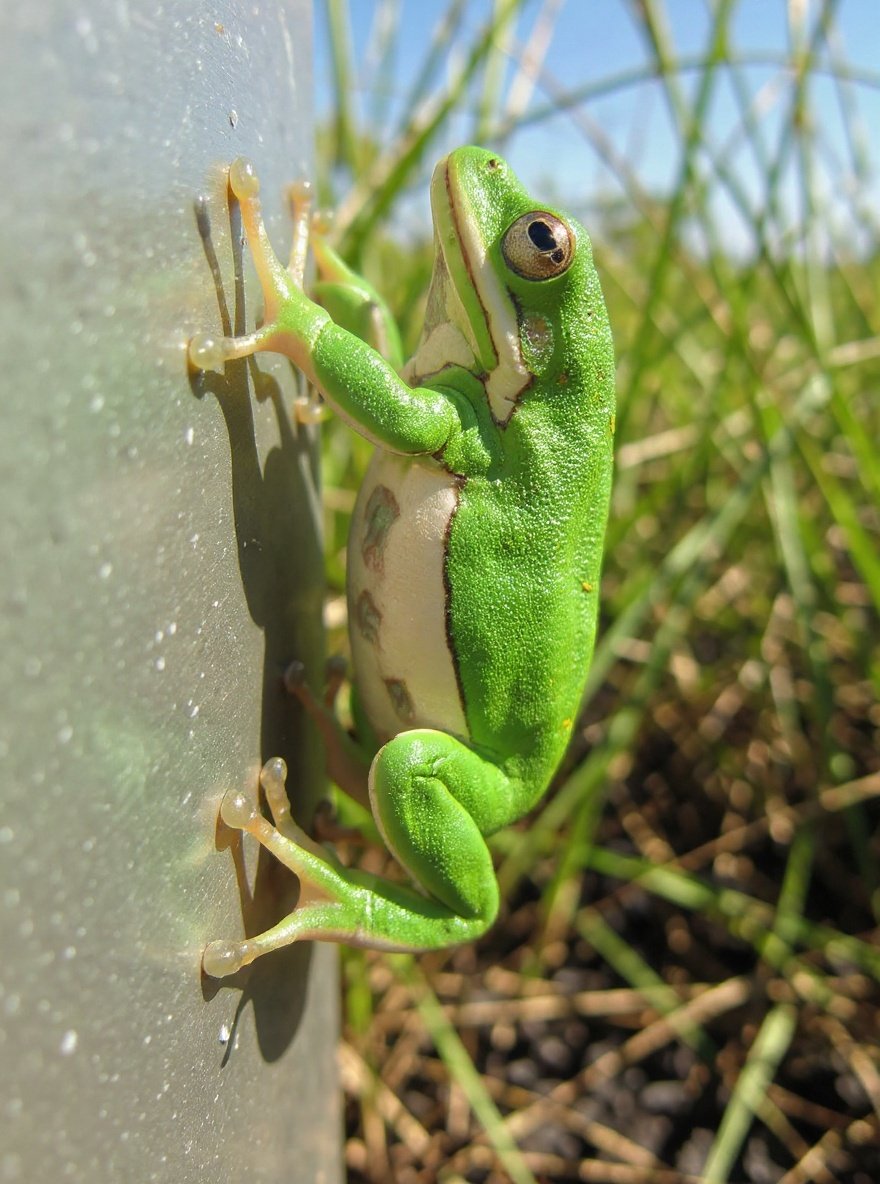
Under a microscope, a tree frog’s toe pad reveals a surface very different from the skin of other animals. According to a study by Federle and colleagues published in the Journal of the Royal Society Interface in 2006, the pad consists of soft epithelial cells about 10 micrometers across, arranged in a hexagonal pattern. The cells are separated from one another by deep channels roughly 1 micrometer wide, into which mucus-secreting glands open. On the surface of each cell there are far finer projections, 0.1–0.4 micrometers in size, called "pegs."
The basis of adhesion is this: the mucus fills the gap between pad and surface, generating capillary and viscous forces — much like a wet paper towel sticking to glass. But the story does not end there. What Federle’s team actually discovered is that the adhesion draws strength not only from the liquid film but also from "boundary friction" at the points where the pad directly touches the surface. Because the channels carry excess water away, the pad does not aquaplane; in other words, there is no situation like a car sliding on a film of water on a wet road. That is why the paper’s title is so telling: "Wet but not slippery."
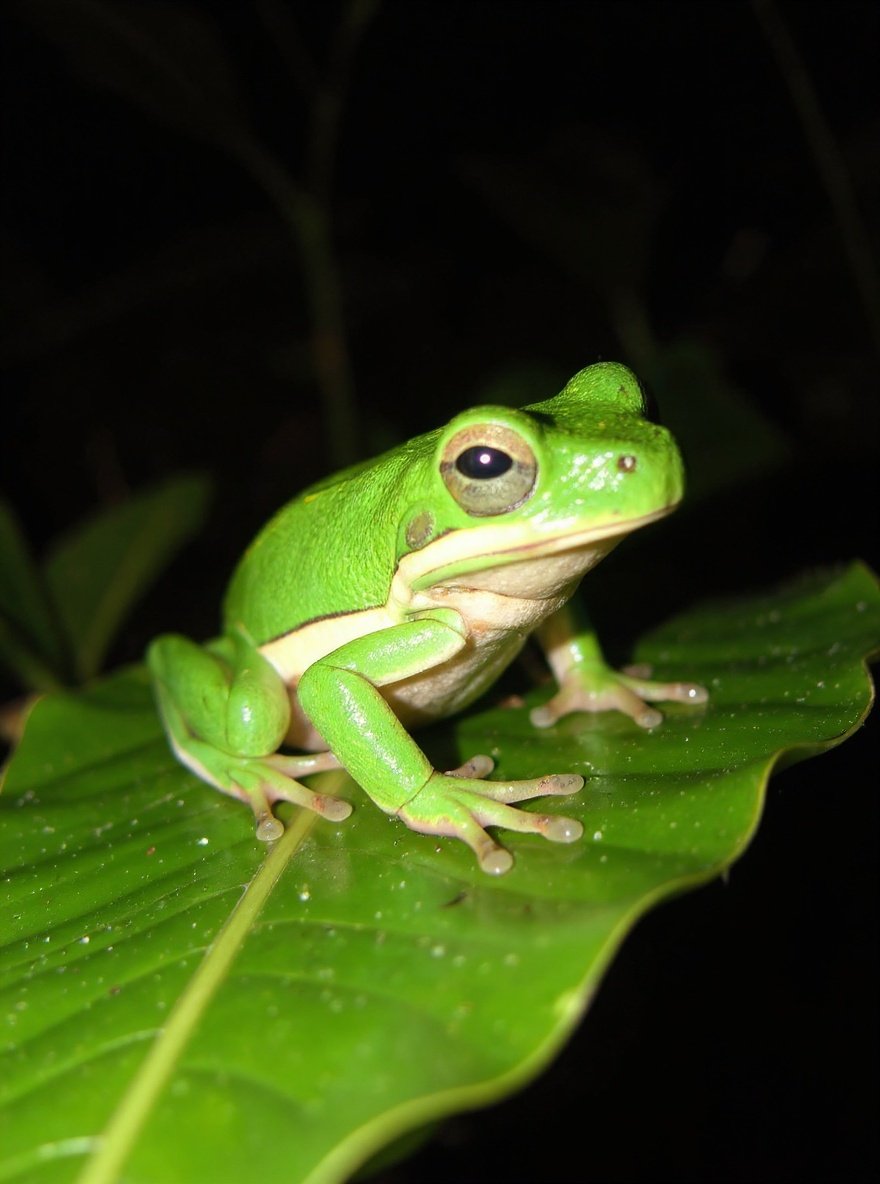
A 2018 review by Langowski and colleagues in Frontiers in Zoology stresses that the continuous secretion and channel-drainage of mucus is the heart of the system: the pad stays wet while water never builds up enough to cause slipping. Measurements by Barnes and Gorb in 2011 showed that the pad is surprisingly soft: its effective elastic modulus is close to that of silicone rubber (about 5–15 MPa). This softness lets the pad conform to a rough surface as if molding to it, increasing the contact area.
The "Wow" Moment
The truly surprising thing here is not that the frog is "sticky." What is surprising is this: water, which in nature is usually the enemy of grip, has been turned into the very source of grip.
Think about it: tape sticks to a dry surface and falls off when it gets wet. The frog does exactly the opposite — it grips precisely because it stays wet, not dry. Without the liquid film there is no capillary force. So what most of us think of as "slippery" has, in this pad, been turned into an advantage. And in this design two opposing needs are met at once: staying wet enough to stick, and shedding enough water not to slip. These two demands normally conflict; the hexagonal cell-and-channel pattern given to the frog is exactly what balances them.
Inspired by Nature
One of the oldest problems in human technology is gripping on wet ground: tires that brake on wet roads, shoes that don’t slip in the rain, surgical tape that adheres to moist skin. The difficulty always knots up in the same place — get rid of the water but don’t lose contact.
The tree frog’s pad inspired engineers at exactly this point. At the University of Akron, mechanical engineering researcher Arnob Banik developed, in 2018, a tire-tread design that grips better on wet ground by mimicking the frog’s toe pad, and won an award for the work. At a more fundamental level, a 2019 review published in Philosophical Transactions of the Royal Society A by a team including Barnes and Gorb describes the "smart adhesives that stick in wet environments" and friction-generating devices developed from toe-pad mimicry. And a 2012 study by del Campo, Barnes and their team recreated the pad’s hexagonal pattern in a soft polymer called PDMS in the lab, showing how this pattern increases wet friction.
There is also an honest limit here. According to a 2020 review in Integrative and Comparative Biology, most human-made mimics copy only the pad’s surface pattern; yet in the frog the internal structures that make the pad work (fiber reinforcement, muscles, mucus control) operate as a whole. So we can still only reproduce the visible face of the system — and even that only as a simplified copy.
Up Close
A biologist placing a frog’s toe under a microscope sees this: the surface is divided into regular hexagons, like a honeycomb. Each hexagon is the top of a soft cell; in the fine grooves between them sits a glistening liquid — mucus. Zoom in further and the surface of each cell reveals thousands of tiny projections, too small to see with the naked eye.
Pull back to a wider scale and the pattern looks familiar: like the tread of a car tire. In fact, naturalists describing the frog’s pad often say it "resembles the tread of a car tire." The difference is this: this tire’s tread is alive, soft, keeps itself wet, and drains water when needed.
A Window for Reflection
In nature, solutions usually arise not from a single part but from the harmony of finely tuned parts. For the frog to grip without slipping, the cells must be the right size, the channels the right width, the mucus the right consistency, and the pad the right softness. If even one of these variables drifts, the grip collapses. Even in a cell ten micrometers wide we see a measure, a balance.
The Qur’an repeatedly calls people to look at the world around them, to pay attention to the fine measure and balance (mīzan) in it. What we observe here is exactly that: at the very tip of a fingertip, a delicate balance built on a scale too small to see. This sight makes a person say not so much "how vast" as "how finely tuned."
Reflection is not a voice raised to cry "this is a miracle"; it is the ability to look calmly at the order that persists even at such a tiny scale. When we look at a frog gripping wet glass, we are really looking at a design that turns water from an obstacle into a friend. Looking closely at a solution this elegant leaves a quiet door open onto careful observation.
What Does It Tell Us Today?
When we look for the solution to a problem, we often think "more force, harder material." The frog shows this is not the only way: sometimes the solution is not to remove the obstacle but to put it to work. Water could have been an obstacle for the frog; yet in it, water has been made the very means of gripping.
The same outlook holds for both the engineer and the thinking person: sometimes the right question is not "how do I defeat this obstacle?" but "how do I turn this obstacle into an advantage?" A surface no bigger than a fingertip reminds us of a way of thinking this large.
Discover, marvel, remember the Creator.
Sources
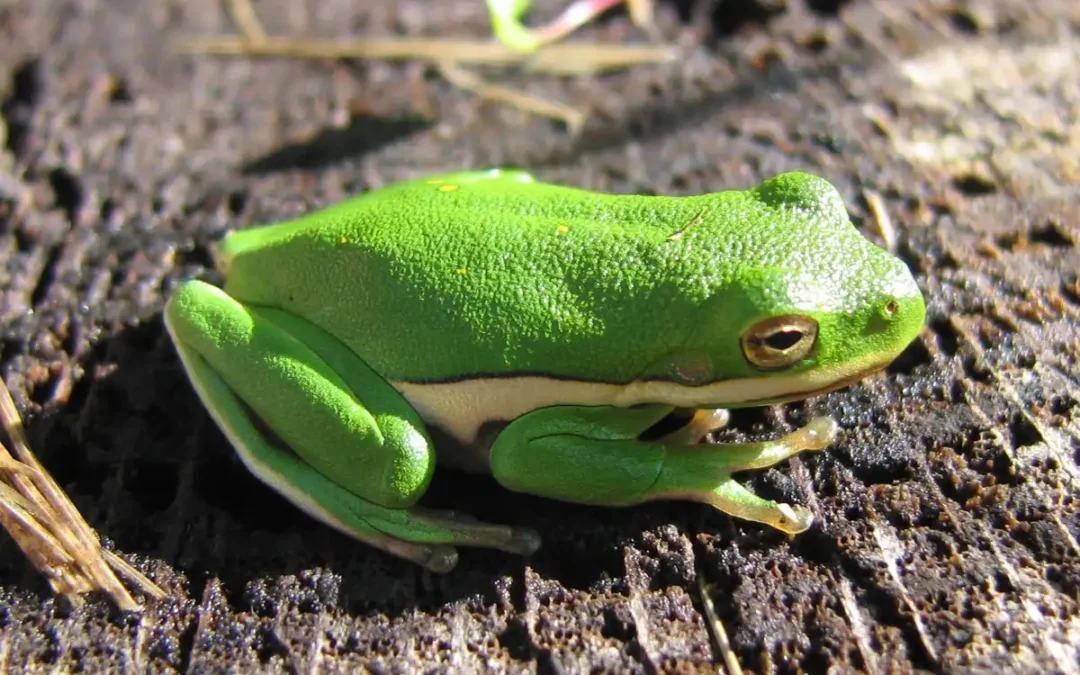
- https://commons.wikimedia.org/wiki/File:Hyla_cinerea2.jpg — Real source photograph used for the hero image (Wikimedia Commons).
- Federle et al., J. R. Soc. Interface, 2006 — "Wet but not slippery"; hexagonal cell/channel structure, capillary + boundary friction. PMC1664653
- Langowski et al., Frontiers in Zoology, 2018 — toe pad mechanism and mucus drainage. PMC6107968
- Barnes, Gorb et al., Phil. Trans. R. Soc. A, 2019 — tree frog adhesion biomimetic applications. Royal Society
- Barnes & Gorb, J. Comp. Physiol. A, 2011 — elastic modulus of the pad. PMC3176399
- del Campo, Barnes et al., Adv. Funct. Mater., 2012 — hexagonal PDMS micropillar mimics. Wiley
- Langowski et al., Integrative and Comparative Biology, 2020 — tree-frog-inspired adhesives; limits of bio-mimicry. Oxford Academic
- University of Akron (A. Banik), 2018 — frog-inspired wet-grip tire tread. uakron.edu
- AskNature (Biomimicry Institute) — toe pad wet adhesion and self-cleaning. asknature.org
Coming soon
Listen to these topics in the app, track your progress.
In the DuaMio app you’ll listen to every topic — not to memorize, but to comprehend.
Image note: The hero image of this article is a real source photograph. The three in-article images were generated with AI from that real reference to illustrate the subject more clearly.
Content note: This article was compiled with AI assistance based on reliable scientific sources and editorially reviewed before publication.