Discovery · Animals · Birds
Short Answer
A significant part of the bright colors in peacock feathers comes not from pigment, but from structures arranged at the nano/micro scale inside the feather. A study published in PNAS shows that the two-dimensional photonic-crystal structure in the barbule cortex region of peacock feathers creates color by selectively reflecting light. For this reason, the color depends not only on a chemical substance like dye, but also on structure.
This mechanism is an inspiring principle for structural color technologies, displays, sensors, and long-lasting color designs.
Real observation video (BBC Earth): as the peacock fans its train, the structural colours shimmer with the changing angle.
What Are We Observing?
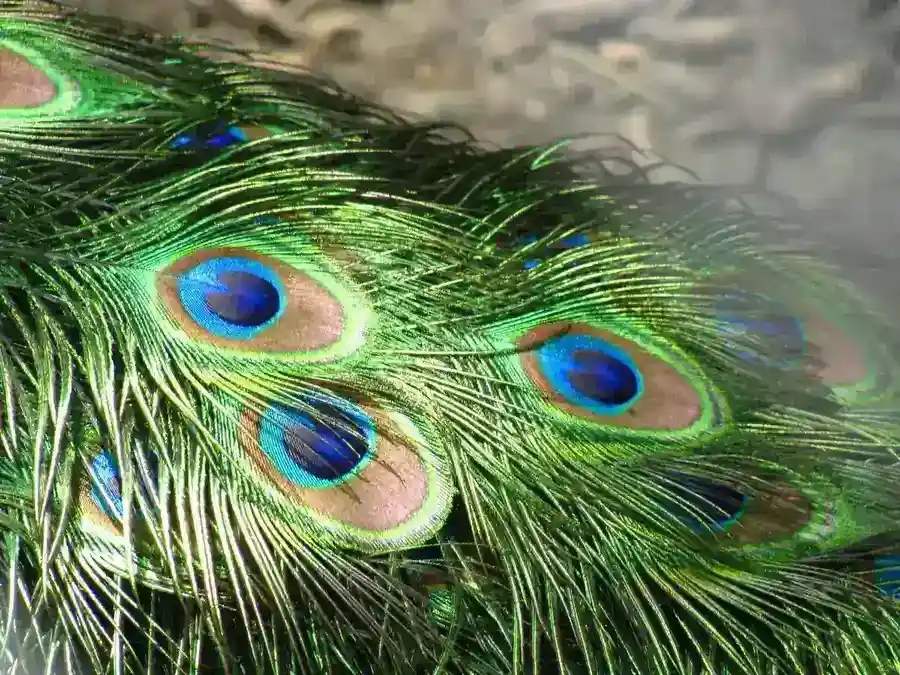
The dazzling blue, green, and gold tones in a peacock’s tail may look painted from a distance. But behind these colors there is not only pigment. The feather’s very small-scale structure interacts with light and reflects certain wavelengths more strongly.
For this reason, the peacock feather makes us rethink the question “what is color?” Color does not always come from a dye substance. Sometimes the structure of a surface arranges light in such a way that our eye perceives a particular color.
The Science
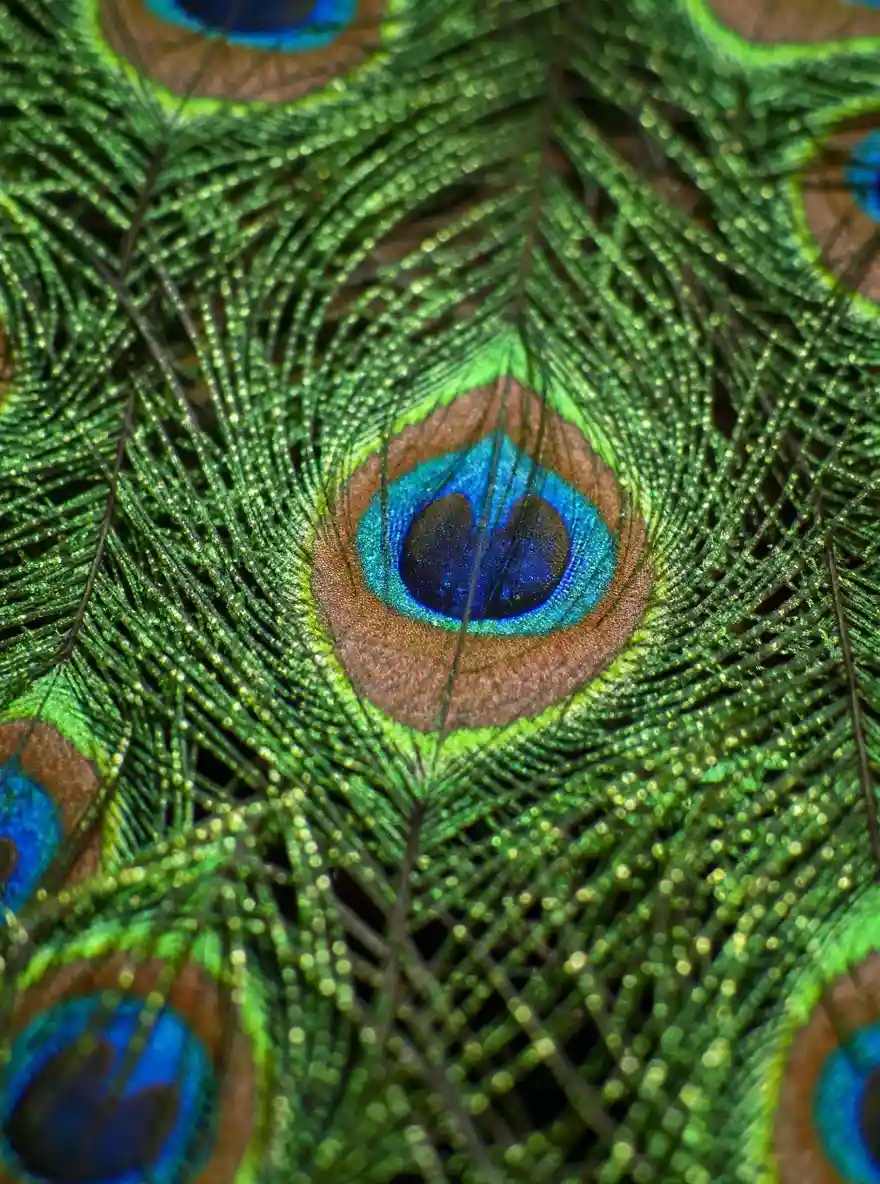
The PNAS study reports that color production in peacock feathers is related to a 2D photonic-crystal structure within the barbule cortex. This structure creates a partial photonic bandgap effect that causes light at certain frequencies to be strongly reflected.
Color diversity is also related to the details of this structure. As the lattice constant, that is, the structural spacing, and the number of periods change, different colors emerge. Thus, the color of the feather is understood not only through the question “which pigment is present?” but also through the question “how does the microstructure arrange light?”
The “Wow” Moment
The “wow” point is this: the color we see in a peacock feather is actually an interaction between light and small structures. In other words, color does not arise like a dye hidden inside the material; it is born from the relationship between light, angle, and structure.
That is why some structural colors remain vivid for a long time. Pigment can fade; but as long as the structural order is not damaged, interaction with light can continue. Of course, the feather can physically wear out; but the principle of color production is different from pigment.
Inspired by Nature
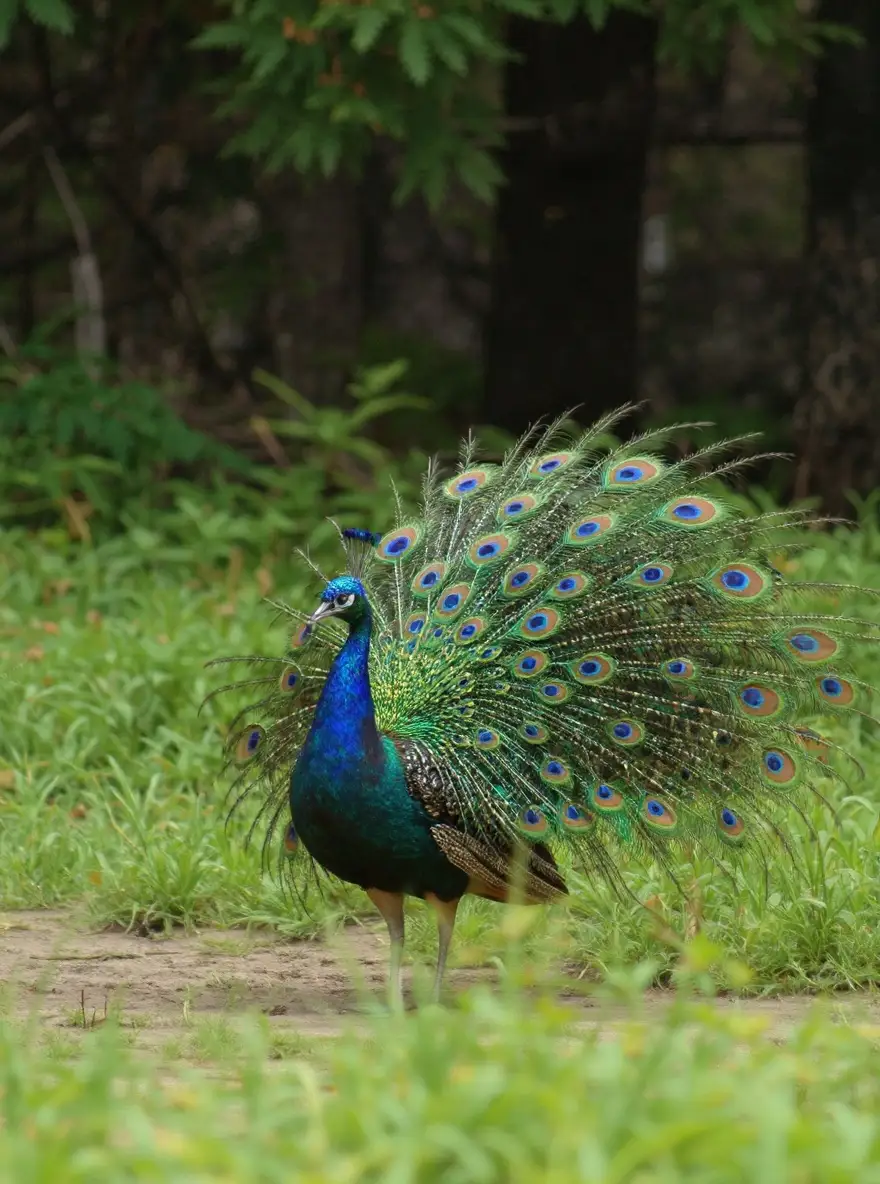
Structural color technologies are now of interest for displays, sensors, security inks, reflective surfaces, and color-changing materials. Photonic crystal-based color systems try to produce specific colors without using pigments.
In bioinspired reflective display studies, photonic crystal structural color is considered an important candidate because of energy efficiency, tunability, and colorfast properties. The peacock feather gives a direct design lesson for this field: it is possible to produce color not from chemical dye, but from organized structure.
Up Close
Think of a soap bubble. The colors on it are not dye; they arise from the interaction of the thin film with light. The structure in a peacock feather works at a much more ordered and special scale. Light strikes the feather’s microstructure; some wavelengths are strengthened, others weakened.
That is why when you watch the feather from different angles, color perception can change. Color emerges together with the angle of incoming light and the order of the structure.
A Window for Reflection
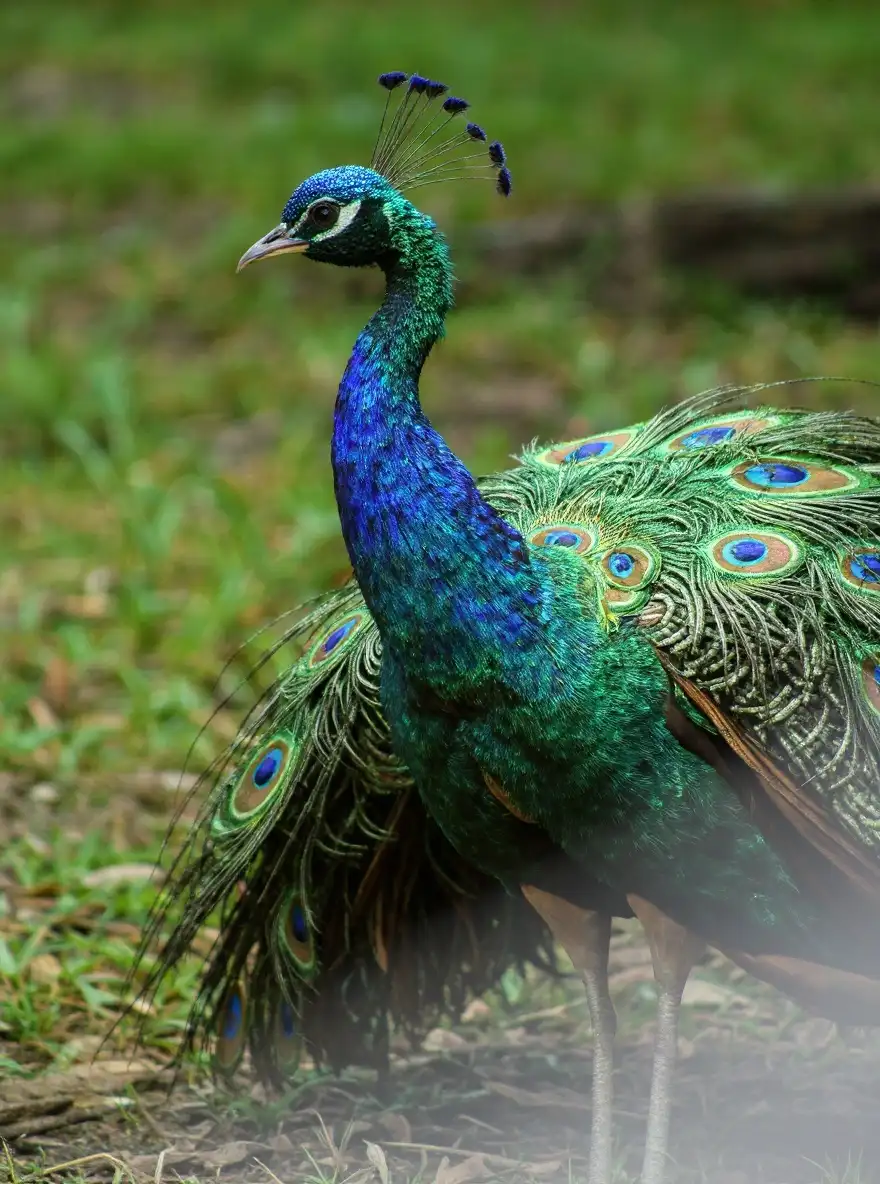
The peacock feather reminds us that beauty is found not only on the outer surface, but also in unseen deep structure. Our eye sees the bright color; science opens the micro-order behind that color. When the two are considered together, wonder deepens even more.
From the perspective of Islamic reflection, these colors are not presented as the result of the bird’s own independent art. One reflects on Allah’s creation, who gave it this feather structure and this order that interacts with light in such a way. Beauty, measure, and physics come together in the same feather.
What It Tells Us Today
This subject tells us that behind visible beauty there may be invisible structures. A person often looks at the result; science investigates the order that produces the result.
For a young reader, the peacock feather teaches this: color can be not only in dye, but also in geometry. When light, structure, and measure come together, dazzling results emerge.
DuaMio Discovery tries to make the invisible order behind a bright feather noticeable. The colors of the peacock show that, when looked at carefully, science and reflection can meet at the same point of wonder.
Discover, marvel, remember the Creator.
Sources
- Hero image source: File:Peacock feathers closeup.jpg
- https://www.pnas.org/doi/10.1073/pnas.2133313100 — 2D photonic-crystal structure and color production in peacock feathers.
- https://pubmed.ncbi.nlm.nih.gov/14557541/ — PubMed record of the same PNAS study.
- https://pmc.ncbi.nlm.nih.gov/articles/PMC240659/ — Open-access PMC record of the same study.
- https://onlinelibrary.wiley.com/doi/full/10.1002/idm2.12138 — Photonic crystal structural color and reflective display technologies.
Coming soon
Listen to these topics in the app, track your progress.
In the DuaMio app you’ll listen to every topic — not to memorize, but to comprehend.
Image note: The hero image of this article is a real source photograph; source here. The three in-article images were generated with AI from that real reference to illustrate the subject more clearly.
Content note: This article was compiled with AI assistance based on reliable scientific sources and editorially reviewed before publication.